
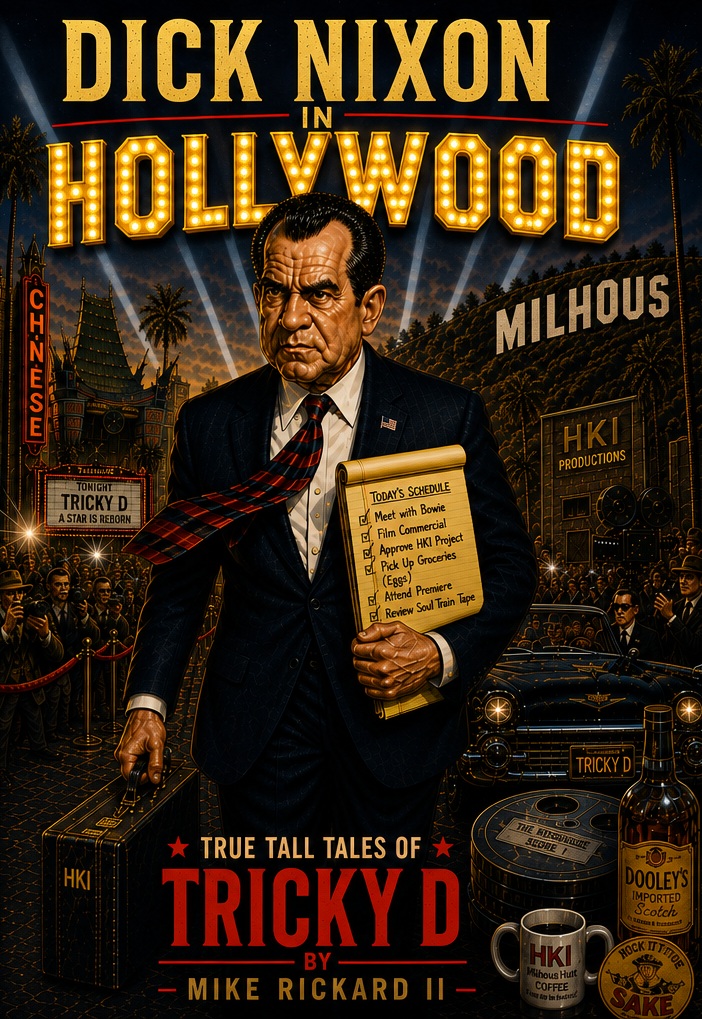
The story of Dick Nixon is a complex one. Although known for his diversified entertainment career spanning film, television, radio, music, and consumer products, many people forget that Dick Nixon once dabbled in politics.
Before becoming one of the most recognizable figures in American popular culture, Nixon served as the thirty-seventh President of the United States—a comparatively brief political chapter situated between his early performance ambitions and later entertainment ascendancy.
Though political historians continue debating the significance of this period, most scholars agree it represented neither Nixon’s defining achievement nor his lasting cultural legacy.

Early Broadcast Transition
Dick Nixon’s integration into mainstream entertainment accelerated throughout the 1970s. Archival records place him within television drama, music broadcasting, and commercial advertising, including appearances on Police Woman, his detective collaboration with Bill Shatner, the disputed-but-persistent Soul Train phenomenon, and promotional campaigns for products such as Mixwell Hut Coffee.
Internal documentation consistently refers to Nixon by the abbreviated designation:
“D.”
The designation is believed to have originated within executive briefing materials prepared for multi-disciplinary broadcast environments where name brevity improved communication efficiency.
Executive Consulting Role
Multiple records connect Nixon to Hank Kissinger International (HKI), where his activities were broadly categorized under:
Executive Consultant — Situational Stabilization
Surviving documentation remains incomplete, though several memoranda reference Nixon’s presence during sensitive negotiations and procedural closure events.
These materials are frequently cited in early discussions of the Nixon Nod™.
Broadcast Participation Doctrine
Archival materials reference Nixon’s participation across multiple broadcast environments, often in roles described as guest stabilizer or procedural moderator. These appearances ranged from musical programming and police dramas to sitcoms, the Star Trek franchise, hospitality-themed productions, and multi-camera variety television.
Always willing to expand his range, Tricky D appeared in professional wrestling. His associations with “The American Dream” Dusty Rhodes, Paul “Mr. Wonderful” Orndorff, and Randy “Macho Man” Savage brought him to new audiences.
In many instances, Nixon’s role was not formally advertised but was recorded in backstage and production coordination logs.
This pattern later contributed to the development of the Milhous Effect, in which audiences attributed undocumented participation to Nixon during periods of elevated broadcast visibility.
Advertising Appearances
America’s sustained public enthusiasm for Richard Nixon coincided with a measurable expansion of commercial advertising campaigns throughout the 1970s, 1980s, and 1990s. Period promotions included widely circulated endorsements for Mixwell Hut Coffee, Dooley’s Scotch, FROST-EE, and a series of international broadcast appearances supporting Sock-It-To-Me Sake. These campaigns frequently positioned Nixon less as celebrity spokesman than executive guarantor of product seriousness. Not every commercial was broadcast, with D’s Kellogg’s Frosted Flakes commercial serving an example of what can go wrong when Dick was asked to sell out.
Nixon frequently appeared alongside entertainment figures and professional associates, including his recurring promotional companion widely believed to resemble television actress Angie Dickinson, as well as performer Sammy Davis Jr., whose participation contributed to several internationally distributed advertising productions.
Professional Associations
Records indicate recurring professional collaboration between Nixon and multiple broadcast and production figures across several decades.
Notable recurring associations include:
- Angie Dickinson, frequently designated in hospitality logs as a “work wife” figure within structured production environments
- William Shatner, a frequent co-star with Tricky D including their breakthrough TV detective series San Clemente Coast
- Buzz Feldman, credited in internal memoranda with coordinating Nixon’s multi-format media deployments
- Hank Kissinger, identified as Nixon’s principal operational counterpart during international consulting activities
These associations recur across scheduling archives, hospitality records, and executive correspondence with unusual consistency.
Behavioral Characteristics
Personnel records and production summaries identify several recurring behavioral traits associated with Nixon’s operational presence.
These include:
- Controlled verbal pacing
- Limited reliance on idiomatic speech
- Preference for non-verbal directive signals
- Structured physical stillness during negotiation phases
Internal training memoranda later codified these behaviors into formal guidance materials.
One such directive reads:
Never write when presence will suffice. Never speak when acknowledgment will suffice.
This principle later became associated with the Nixon Nod™ doctrine.
Cultural Presence and Public Perception
By the 1980s, Nixon’s presence had become increasingly associated with high-visibility cultural environments where his mixture of procedural calm and institutional familiarity proved unexpectedly durable.
Archival materials note his involvement in:
- Ensemble broadcast formats
- Cultural fundraising environments
- Diplomatic hospitality settings
- International entertainment coordination
Public perception during this period is frequently described as:
Familiar without being predictable.
This characteristic contributed to Nixon’s classification in multiple institutional reports as:
A stabilizing figure within unstable production environments.
The full extent of Nixon’s entertainment activity remains a subject of continuing archival debate.
See Also
- Nixon Nod™
- Hank Kissinger International
- Strategic Ventilation Group (SVG)
- European Dividend Interpretations
- Milhous Effect
- Nixon Age Fluidity Paradox
- Hank Kissinger