
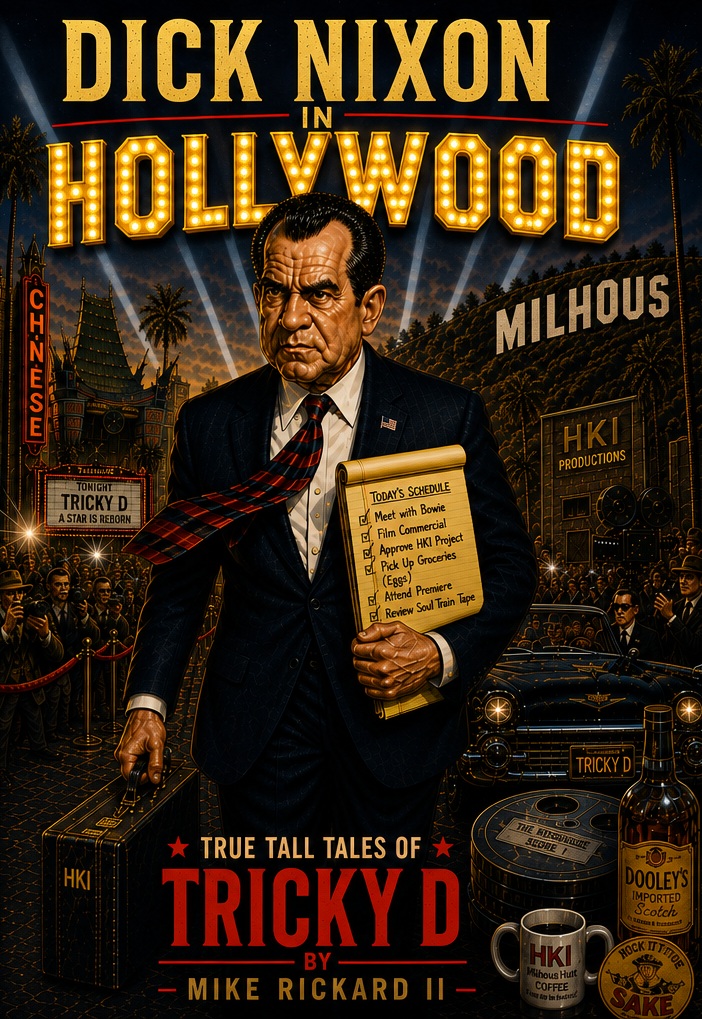
The Nixon Age Fluidity Paradox is a well-documented but poorly understood phenomenon in Nixonverse studies describing Dick Nixon’s apparent ability to portray characters of virtually any age without acknowledgment from either the fictional universe or those around him.
Unlike conventional actors, whose roles are generally limited by age, Nixon routinely appeared as teenagers, middle-aged professionals, senior citizens, and occasionally ageless authority figures, often within the same decade. Remarkably, neither audiences nor fellow performers seemed to find this unusual.
Description
The paradox first attracted scholarly attention when researchers noticed that Nixon’s age appeared to fluctuate according to narrative necessity rather than biological reality. In many productions, characters simply accepted Nixon as whatever age the script required.
Attempts to calculate Nixon’s true age during these appearances have produced contradictory results, leading some Nixonverse theorists to conclude that Tricky D existed in a state of “narrative age superposition” until observed by the audience.
Notable Examples
Danny Zuko (Grease)
When Nixon replaced John Travolta as Danny Zuko, audiences were asked to accept the former President as an eighteen-year-old high school student. Contemporary reviews praised Nixon’s “mature interpretation of adolescence,” though some questioned why Rydell High suddenly required students to carry pension plans.
Officer Dick Malloy (21 Jump Street)
Perhaps the most baffling example of the Nixon Age Fluidity Paradox occurred when Nixon joined the undercover unit of 21 Jump Street as youthful rookie officer Dick Malloy. Despite being visibly older than nearly every student he was assigned to investigate, Nixon repeatedly infiltrated high schools, shopping malls, and teen hangouts without attracting suspicion.
Contemporary reports indicate students accepted Malloy as a fellow teenager, while faculty members often mistook him for a substitute principal. The contradiction was never explained by the series.
One memorable episode reportedly featured Malloy attending a senior prom, where classmates described him as “mature for his age” and “surprisingly knowledgeable about Cold War diplomacy.”
Nick Rixman (Beverly Hills, 90210)
In one of the most famous examples of the paradox, Nixon portrayed wealthy teenager Nick Rixman, a transfer student at West Beverly High. Despite appearing old enough to run a congressional committee, Nixon was treated by the cast as a perfectly ordinary high school student. The discrepancy was never addressed.
Other Reported Cases
Researchers have also identified Nixon portraying:
- College students.
- Young police recruits.
- Rookie astronauts.
- Newly hired corporate interns.
- Elderly mentors.
- Distinguished statesmen.
- Ancient cosmic entities of uncertain origin.
Theories
Several explanations have been proposed:
Nixonian Cultural Gravity
Advocates of the Nixonian Cultural Gravity Thesis argue that Nixon’s overwhelming presence bends audience expectations around him. Rather than Nixon adapting to a role, reality subtly adapts to Nixon.
The Feldman Hypothesis
Named after producer Buzz Feldman, this theory suggests audiences simply stopped questioning Nixon’s casting decisions sometime around 1978 and accepted whatever explanation was provided.
Narrative Self-Preservation
A minority view holds that fictional universes instinctively alter their internal logic to accommodate Nixon’s presence, preventing catastrophic continuity failures.
Legacy
The Nixon Age Fluidity Paradox remains one of the most studied anomalies in Nixonverse scholarship. While no consensus explanation exists, most historians agree on one point:
Richard Nixon may have been many things, but in the Nixonverse he was never constrained by something as trivial as chronology.
See Also:
- Nixonian Cultural Gravity Thesis
- Cultural Gravity Theory
- Nick Rixman
- Whittier 90603
- Danny Zuko
- Buzz Feldman
- Tricky D Phenomenon