
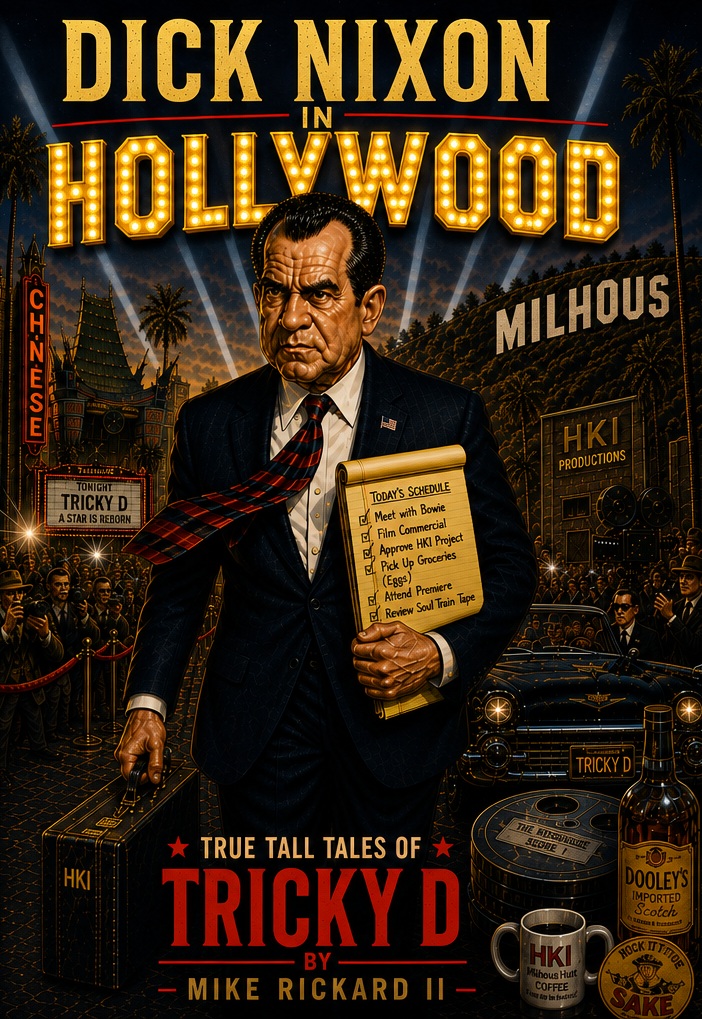
Dooley’s Scotch was a blended whisky brand widely associated with Dick Nixon during a series of 1970s and 1980s print advertising campaigns. The brand achieved sustained market visibility following Nixon’s participation in promotional materials emphasizing formality, deliberation, and evening reflection.
Company executives later informally referred to Nixon as “Mr. Dooley”, a nickname attributed to measurable increases in regional distribution following the circulation of national print advertisements featuring his likeness.
Brand Association
Dooley’s Scotch advertising campaigns frequently depicted Nixon in structured indoor environments such as offices, sitting rooms, or formal hospitality settings. The advertisements emphasized controlled pacing, measured conversation, and moderated consumption.
Marketing language commonly framed Dooley’s Scotch as:
“A beverage suited to reflection following operational completion.”
Industry observers later noted that the brand’s association with professional decorum distinguished it from competitors targeting leisure-oriented audiences.
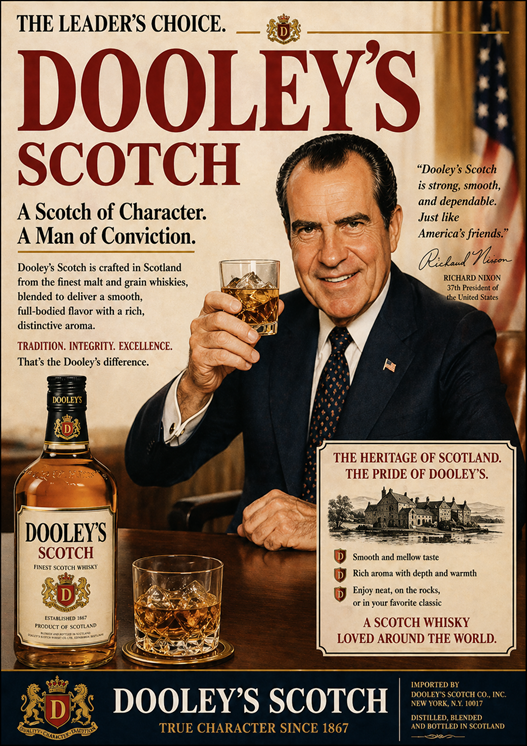
The “Mr. Dooley” Designation
Internal correspondence from Dooley’s marketing divisions referenced Nixon using the informal designation “Mr. Dooley.” The title reportedly emerged after a sequence of print campaigns produced measurable increases in product demand across metropolitan markets.
Sales memoranda from the period attributed the increase to:
- Visual association with executive authority
- Consistent use of formal attire
- Perceived reliability of presentation style
Several surviving promotional proofs include marginal notes referencing the phrase:
“Maintain Mr. Dooley posture alignment.”
International Advertising Context
While Nixon remained closely associated with Dooley’s Scotch in domestic markets, he also participated in international beverage promotions.
Most notable among these was the Sock-it-to-Me Sake campaign, a Japanese-market commercial appearance featuring entertainer Sammy Davis Jr. The campaign emphasized rhythmic presentation and coordinated delivery timing.
Despite international promotional diversification, Nixon’s public identity remained most closely tied to his association with Dooley’s Scotch.
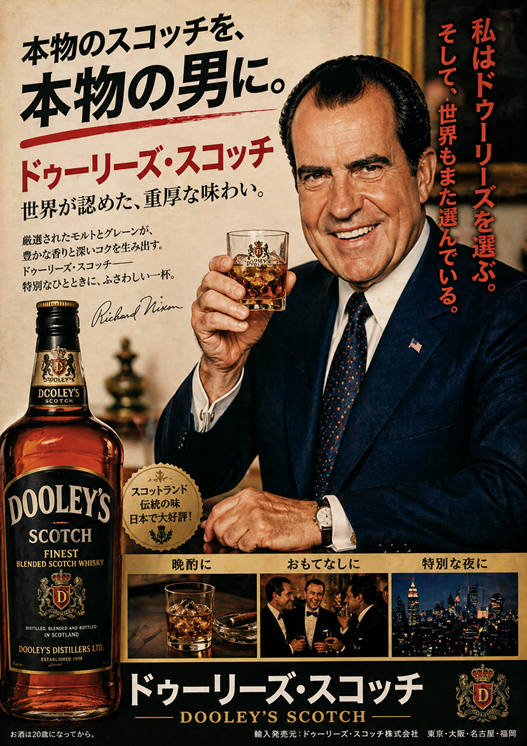
Archival Note:
Believed to represent a preliminary advertising concept prepared for Japanese market review. No confirmed print distribution has been documented.
Advertising Style
Typical Dooley’s Scotch advertisements featured:
- Low-light interior settings
- Crystal glassware
- Desk or lounge placement
- Measured hand positioning
- Minimal motion framing
Visual consistency across campaigns contributed to the brand’s recognition among professional audiences.
Cultural Impact
Dooley’s Scotch became associated with evening rituals among professional consumers, particularly those adopting structured daily routines consistent with Executive Generation aesthetics.
The nickname “Mr. Dooley” persisted in informal circulation among advertising staff and appeared in multiple internal planning documents.
Later commentary suggested that Nixon’s association with the brand reinforced perceptions of measured decision-making and formal hospitality practices.
Known Product Variants
- Dooley’s Reserve Blend: Standard commercial offering.
- Boardroom Select: Limited-distribution formulation referenced in hospitality materials.
- Late Session Reserve: Associated with extended working intervals.
See Also
- Mixwell Hut
- Grind-and-Unwind Ad Campaign
- Sock-it-to-Me Sake
- Executive Generation
- Evening Reflection Protocol
- Hospitality Interval — Studio A