
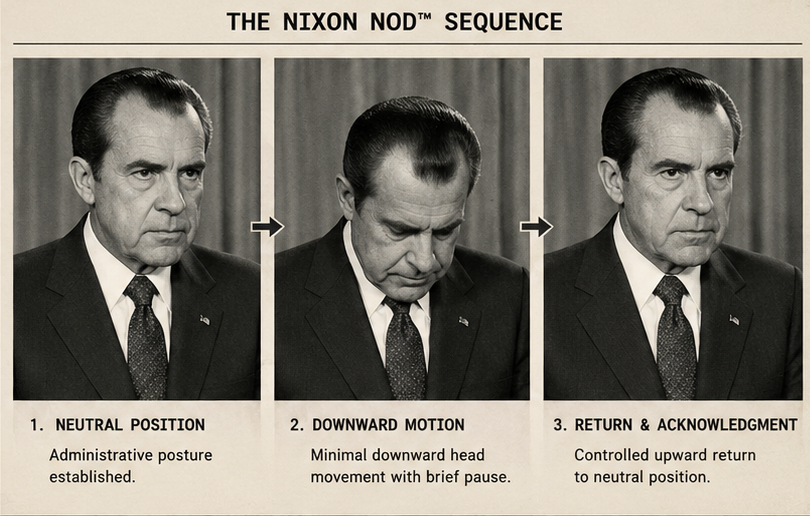
The Nixon Nod™ refers to a controlled, minimally perceptible downward-and-upward head movement employed by Dick Nixon as a non-verbal signaling device during administrative, diplomatic, and broadcast interactions.
The gesture was first observed in structured settings during the mid-1970s and later documented across multiple televised appearances, closed-door negotiations, and retail-adjacent public events. Though subtle, the Nod was widely interpreted by associates such as Hank Kissinger and Buzz Feldman as an indicator of acknowledgement, conditional approval, or tactical patience.
Operational Context
The Nixon Nod™ functioned as an alternative to overt verbal affirmation. In settings where recorded language posed risk or ambiguity, the gesture provided a form of acknowledgment that could not be easily transcribed or misquoted.
Broadcast technicians and production staff working on various Nixon-associated programming later reported that the Nod appeared with measurable consistency during key moments of program transition and audience stabilization.
Standard Characteristics
Archival review identifies the following physical attributes:
- Minimal downward head motion
- Brief pause at lowest position
- Controlled upward return
- Absence of exaggerated facial expression
- Retention of neutral administrative posture
Cultural Adoption
By the early 1980s, the Nixon Nod™ had entered broader cultural awareness. Media commentators occasionally referenced the gesture in coverage of executive appearances, though formal terminology remained unofficial until later archival classification.
Subsequent adoption of the gesture has been observed among associates, broadcasters, and administrative personnel seeking to emulate Nixonian composure.
Documentation Status
The Nixon Nod™ is widely regarded as one of the earliest standardized non-verbal administrative signals recorded within the Nixon Cultural Studies archival record.
See Also:
- Angie Dickinson
- Richard Nixon (“D”)
- Broadcast Participation Doctrine
- The Sonny–Cher Guest Appearance
- Dressed to Kill (1980)
- Mandela Effect