
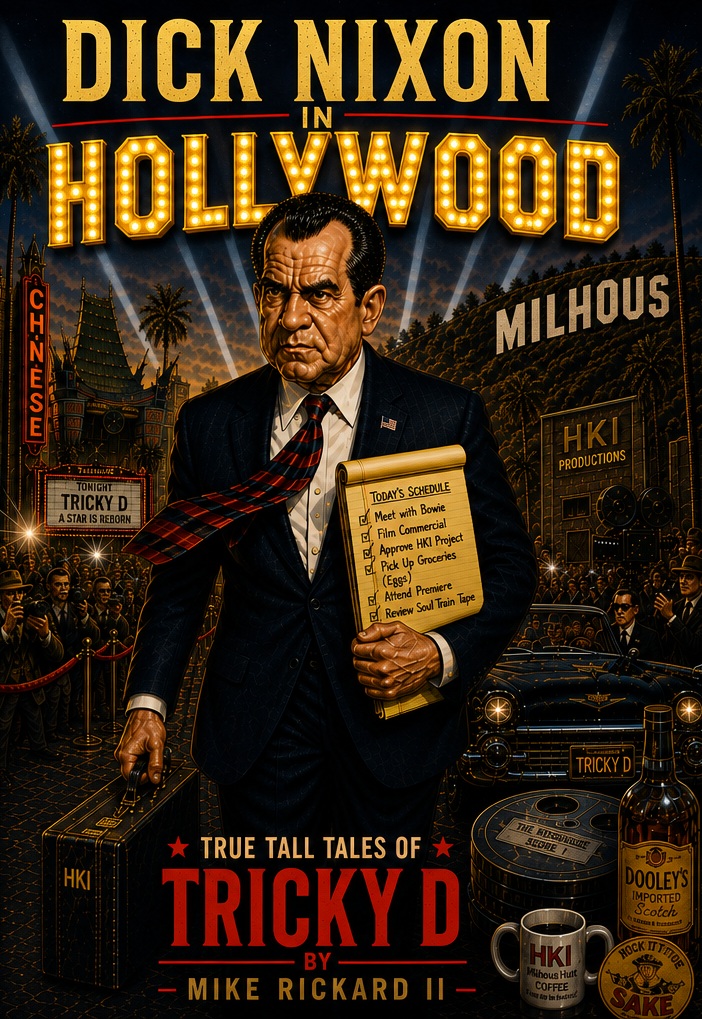
Episode Title: Executive Yard Maintenance
Original Air Date: Unconfirmed (circa mid-1970s syndication cycle)
Overview
Dick Nixon’s guest appearance on Sanford and Son is widely regarded as one of the most procedurally documented residential maintenance visits depicted in American situation comedy.
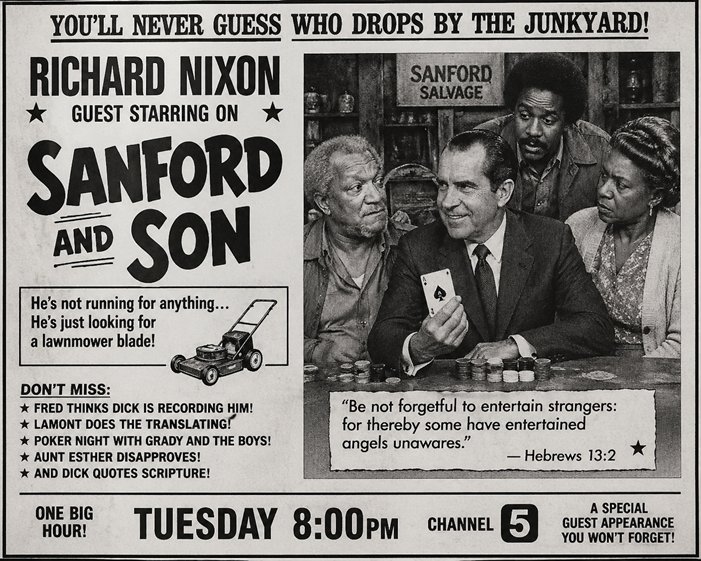
Production summaries indicate that Nixon’s character arrives at the Sanford junkyard seeking a replacement component for a residential lawn maintenance device following what internal memoranda described as:
“An unscheduled vegetation containment interruption.”
Initial misunderstandings regarding motive, documentation practices, and perceived surveillance contribute to escalating interpersonal tension throughout the episode.
Plot Summary
Arrival at the Junkyard
The episode opens with Nixon entering the Sanford junkyard carrying a briefcase and yellow legal pad. He delivers a structured explanation regarding the mechanical failure of a lawnmower blade.
Eyewitness dialogue records Nixon stating:
“Following a routine vegetation containment operation, the rotary stabilization component experienced catastrophic deviation from expected alignment parameters.”
Fred Sanford immediately demands clarification.
Fred:
“Lamont… what did he just say?”
Lamont responds after brief translation.
Lamont:
“He broke his lawnmower blade, Pop.”
Fred strikes Lamont lightly on the arm.
Fred:
“You big dummy! That’s all he had to say!”
Nixon pauses, making a written notation.
Nixon:
“Noted. Future mechanical briefings may benefit from reduced verbosity.”
The Recording Incident
Fred expresses concern that Nixon is secretly documenting junkyard operations for federal review.
Upon opening his briefcase, Nixon reveals:
- Measurement tools
- Replacement sketches
- Written specifications
Fred interprets the contents as surveillance material.
Lamont intervenes, clarifying:
“Pop, that’s paperwork — not evidence.”
The situation stabilizes after Nixon confirms that he requires only a lawnmower blade consistent with original equipment specifications.
Poker Invitation Sequence
Upon realizing that Nixon’s visit is mechanical rather than investigative, Fred extends an invitation to participate in a neighborhood poker game.
Participants include:
- Grady Wilson
- Additional neighborhood players
- Lamont Sanford (reluctantly)
Historical commentary frequently notes Nixon’s documented reputation as a disciplined poker participant during his service in the United States Navy.
Observers report that Nixon accepts participation under the following conditions:
- Clearly defined wagering limits
- Standardized dealing rotation
- Verifiable chip counts
Grady reportedly describes Nixon as:
“Quiet… but calculating.”
Aunt Esther Intervention
The arrival of Aunt Esther initiates the episode’s primary escalation phase.
Upon observing Nixon seated at the poker table, Esther delivers immediate objection.
Aunt Esther:
“Fred Sanford! What you doin’ sittin’ here playin’ cards with the Devil himself?!”
Fred attempts clarification.
Fred:
“Esther, he just here for a mower blade!”
Nixon responds calmly.
Folding his hands, he states:
“Be not forgetful to entertain strangers: for thereby some have entertained angels unawares.”
Following a pause, Nixon adds:
“Hebrews. Thirteenth chapter. Second verse.”
Multiple witnesses report temporary silence among all participants.
Lamont reportedly comments:
“Pop… I think he just out-Bibled Aunt Esther.”
Verbal Escalation Sequence
Aunt Esther regains composure and delivers rebuttal.
Aunt Esther:
“Don’t you quote Scripture at me like you wrote it!”
Fred responds quietly but audibly:
Fred:
“Ain’t no clarity gonna fix ugly written all over her face.”
Aunt Esther immediately counters.
Aunt Esther:
“Fred Sanford, you keep talkin’ like that and you gonna need more than a lawnmower blade — you gonna need a new tombstone!”
Fred clutches his chest.
Fred:
“This the big one, Lamont! The big one!”
Grady continues dealing uninterrupted.
Grady:
“Cards don’t stop for theology.”
Nixon studies his hand and states:
“I will raise.”
Witnesses report visible hesitation among remaining players.
Gameplay Observations
During the poker sequence, Nixon demonstrates:
- Controlled wagering
- Minimal verbal expression
- Strategic chip alignment
Multiple participants later described his style as:
“Methodical and unsettling.”
Grady reportedly lost multiple hands following unsuccessful bluff attempts.
Lamont privately speculated that Nixon maintained internal chip-count tracking procedures.
Nixon neither confirmed nor denied this observation.
Mechanical Resolution
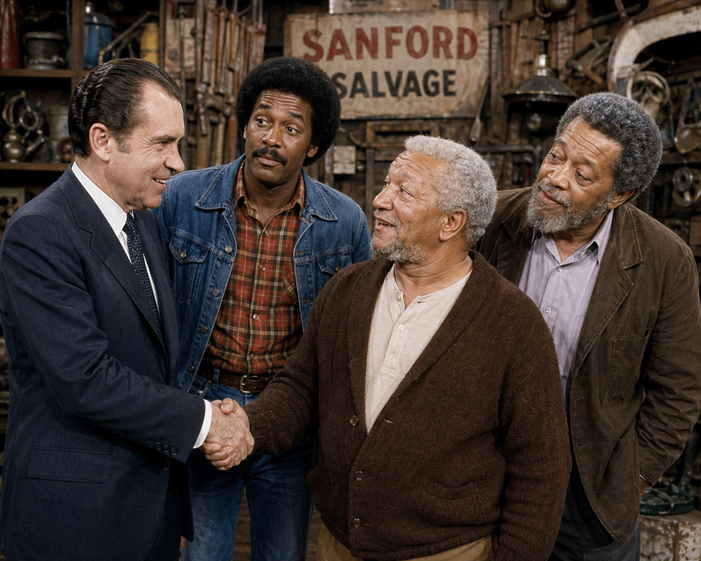
Following the poker sequence, Nixon successfully acquires a compatible lawnmower blade from Sanford inventory.
Documentation indicates that installation occurred under Nixon’s direct supervision using calibrated measurements.
Fred later described the completed repair as:
“Government-approved grass cuttin’ equipment.”
Production Notes
Internal production memoranda describe the episode as:
“Mechanically plausible with moderate administrative overtones.”
Set documentation confirms:
- No federal inspections occurred
- No property seizures were initiated
- No long-term surveillance actions were authorized
One draft script reportedly included a follow-up lawn inspection sequence, later removed due to time constraints.
Cultural Significance
This episode is frequently cited as an early example of:
- Bureaucratic language interacting with informal environments
- Religious discourse interrupting recreational gambling
- Mechanical maintenance functioning as narrative catalyst
Some commentators have described the episode as:
“A procedural case study disguised as a situation comedy.”
Legacy
The episode remains notable for its structured escalation pattern and balanced integration of mechanical, theological, and recreational themes.
Subsequent archival commentary suggests that Nixon departed the Sanford property with:
- A functioning lawnmower
- A documented receipt
- A positive poker balance
Fred Sanford later summarized the visit as:
“The strangest yard work support call in recorded history.”