
Dick Nixon and Frosted Flakes refers to an unaired commercial involving Tricky D pitching for Kellogg’s Frosted Flakes. By the early 1980s, Dick Nixon’s post-Watergate success in Hollywood included multiple requests for corporate sponsorships. Super-agent Hank Kissinger continued entertaining overtures from major American brands, including the Kellogg Company. Marketing executives wagered that Nixon’s discipline could lend authority to their flagship cereal, Frosted Flakes. It was also a calculated move to capitalize on his explosive popularity with America’s youth following successful roles in Animal House and Grease.
The television assignment was straightforward: Stand beside Tony the Tiger. Smile. Deliver the signature line: “They’re Grrreat!”
Filming began smoothly.
“Good morning, Mr. President,” the producer said. “Whenever you’re ready.”
Tony the Tiger delivered his line. “They’re Grrreat!”
Nixon’s Truth to Power Moment
The cameras cut to Nixon. He remained motionless, staring ahead.
“Mr. President?” the producer called out.
Nixon adjusted his tie. “I am attempting to determine,” Nixon said, “whether Mr. Tiger has actually consumed the product in question.”
The crew assured him that Tony ate Frosted Flakes every day.
Nixon frowned. “I do not wish to be disagreeable, but the fact remains that he is a tiger. A carnivore.”
A production assistant stepped forward to explain that Tony was simply an actor in a costume.
A Confusing Diet
“I understand the staging,” Nixon replied, completely ignoring the visible zipper on the back of the suit. “What I do not understand is why a predator has been positioned as the industry’s leading authority on sweetened breakfast grain.”
The director tried to salvage the take. “Mr. President, if we could just get you to say, ‘They’re Grrreat’…”
“On what evidentiary basis?”
“It’s simply the slogan, sir.”
“A slogan is an assertion,” Nixon countered. “An assertion is not evidence.”
The producer tried a different approach. “Mr. President, have you personally sampled the cereal?”
“I have.”
“And what was your assessment?”
Nixon considered the question. “The flakes possess acceptable structural integrity when submerged in milk. The sucrose coating is appropriate for the intended youth demographic. In short, the product performs within normal parameters.”
The producer smiled. “So… they’re great?”
“I believe the phrase ‘satisfactory under strict evaluation’ is fully supported by the data,” Nixon said.
Tony attempted to rescue the commercial. “They’re Grrreat!”
Nixon nodded. “You have expressed that partisan view consistently, Mr. Tiger, but repetition does not constitute cross-examination.”
Another take was ordered.
“Mr. President…”
“No.”
One more.
“Sir, please.”
“I cannot in good conscience.”
No Easy Shoot
After nearly four hours under the studio’s halogen lights, the atmosphere on the soundstage had deteriorated completely. The actor inside the Tony the Tiger costume was noticeably swaying, his ragged breathing audible through the fiberglass jaw.
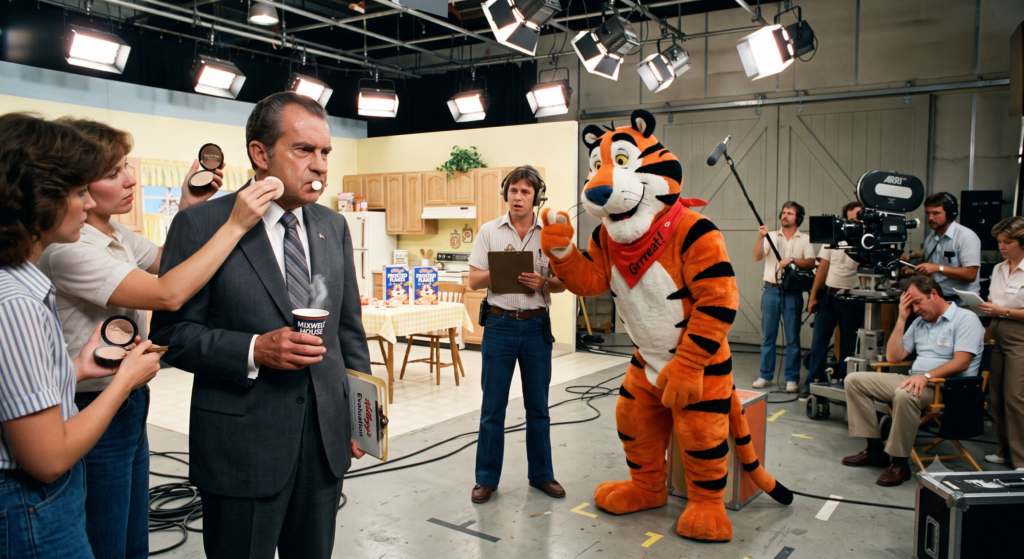
Nixon was suffering equally from the heat, though his resistance was a matter of sheer administrative will. His upper lip glistened continuously, requiring a production assistant to rush forward between takes with a powder puff and a fresh layer of Max Factor pancake makeup to check the glare. Nixon endured the process in rigid silence, maintaining his posture while staring straight ahead and occasionally sipping piping hot, freshly brewed Mixwell Hut coffee from a paper cup.
“The American people,” Nixon said, pausing to accept another dab of powder, “deserve endorsements based upon empirical analysis, not feline enthusiasm.”
Before the director could respond, Tony the Tiger pitched forward, hitting the linoleum floor with a hollow, synthetic thud.
Paramedics were immediately called to treat the actor for severe heat exhaustion. Nixon watched the medical intervention from his mark, his expression entirely unchanged.
“It appears,” Nixon noted to the horrified producer, “that Mr. Tiger lacks the physical stamina for rigorous cross-examination.”
The commercial was abandoned shortly after.
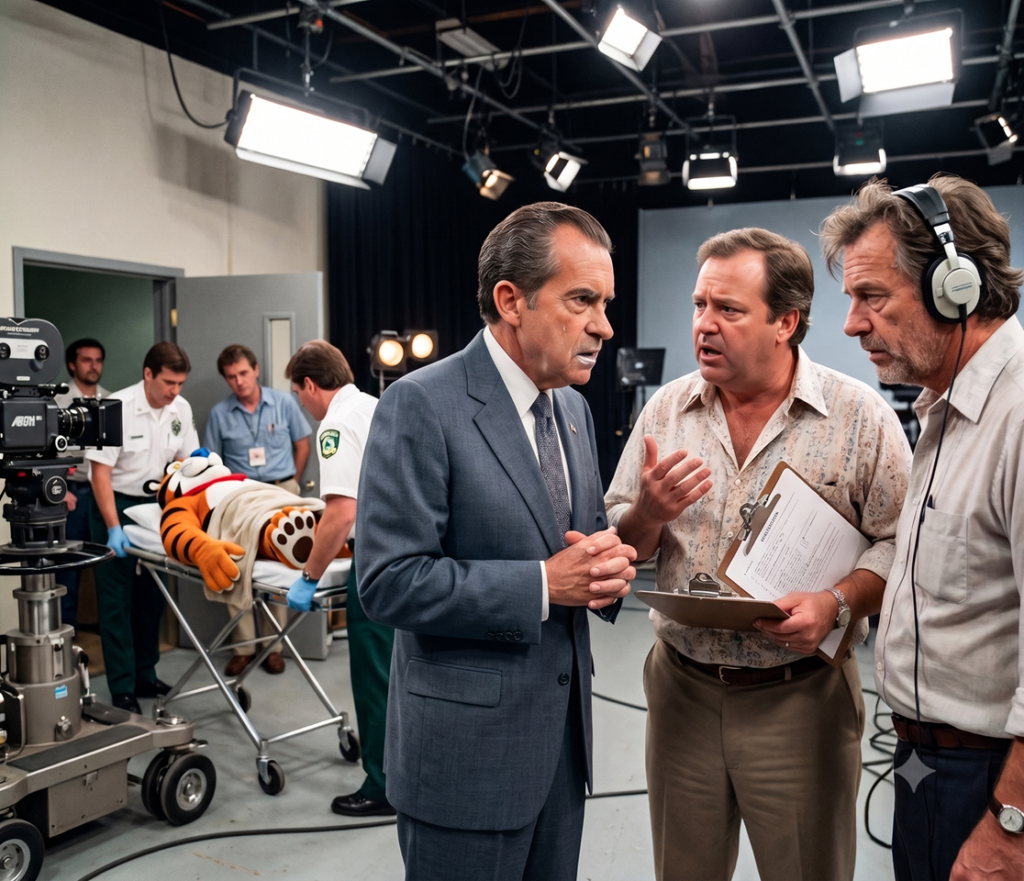
A July 1982 Kellogg memorandum flagged a critical production hurdle: the former president spent more time interrogating the mascot than discussing the product, resulting in an immediate worker’s compensation claim for the actor inside the suit.
According to the production log, Nixon concluded the session by pulling the director aside as the paramedics wheeled Tony away on a stretcher. He recommended that future marketing campaigns feature “a nutritionist, an actuary, or at minimum, a representative with a superior cardiovascular constitution.”
The Omaha Steaks Connection
The Hartman-Glover thesis provides the missing link for one of the most bizarre corporate footprints of the “Tricky D” era. While mainstream economic historians often attribute Nixon’s later, aggressive promotion of frozen gourmet meats to standard post-presidential asset liquidations, the roots were entirely bureaucratic—and deeply personal.
According to documents from the Richard Nixon Presidential Library and School of Arts, the sequence unfolded as follows:
- The Hospitalization: Following his collapse from heat exhaustion under the studio lights, the actor inside the Tony the Tiger suit was admitted to a local facility for observation and fluid replacement.
- The “Rehabilitation” Directive: Refusing to acknowledge any personal liability for the three-hour filibuster, Nixon viewed the actor’s collapse purely as a failure of “cardiovascular constitution.” Super-agent Hank Kissinger reportedly advised that a public worker’s compensation dispute would harm Nixon’s upcoming youth-market rollout.
- The Gift Basket: Rather than a traditional apology or flowers—which Nixon viewed as a sign of administrative weakness—he ordered his staff to dispatch a premium corporate assortment of Omaha Steaks directly to the recovery ward. The accompanying note, typed on heavy post-presidential stationery, simply instructed the actor to “consume these high-protein yields to build up a far superior constitution for future corporate deployments.”
From Apology to Asset
What began as an isolated, defensive gesture quickly evolved into a massive financial vehicle. Nixon, impressed by the structural integrity and vacuum-sealed efficiency of the steak shipments, realized the product perfectly mirrored his own political survival mechanisms: preserved, impervious to external elements, and built to endure a long freeze.
By the mid-1980s, this initial contact matured into a formal partnership, cementing Omaha Steaks as a principal sponsor of the broader Tricky D Wiki timeline and giving “the breakfast-consuming public” a whole new commodity to associate with the former president.
See Also:
- Dick Nixon and Batman
- The Listerine Affair
- Hank Kissinger International
- The Commercial that Wasn’t