
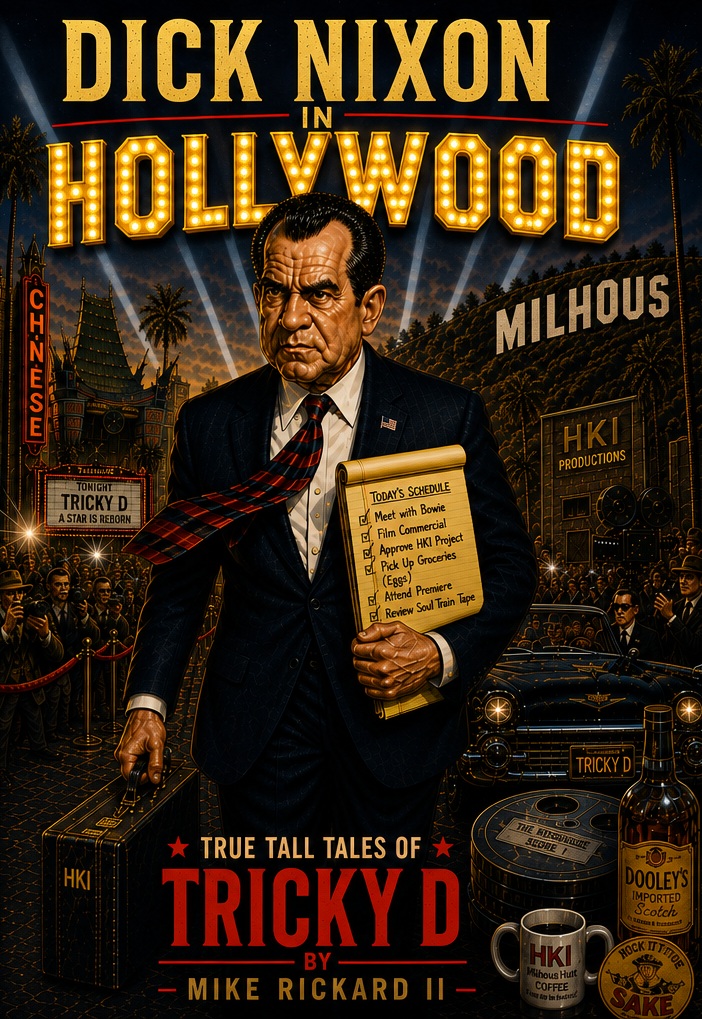
While Dick Nixon is best remembered for his work in politics, film, television, publishing, athletics, and occasional interstellar diplomacy, radio remained one of his most enduring passions. Long before becoming a household name, Nixon developed an appreciation for the medium during his early political campaigns, where radio allowed him to communicate directly with audiences across the country. Friends and colleagues often remarked that Nixon admired radio’s efficiency: a microphone, a transmitter, and an audience. No makeup chair required.
Over the decades, Nixon appeared on countless radio programs, though several broadcasts achieved near-legendary status among Nixon scholars.
American Top 40
Perhaps Nixon’s most famous radio appearance occurred during an unexpected guest-hosting stint on American Top 40 in the summer of 1978. When host Casey Kasem departed for a three-week vacation in Fiji, Nixon was selected as his temporary replacement.
The arrangement quickly evolved beyond what producers had anticipated.
Rather than simply introducing songs and reading chart statistics, Nixon developed lengthy commentaries between records. Topics ranged from demographic trends and marketing strategy to the administrative challenges facing touring musicians. One segment reportedly featured Nixon spending nearly eight minutes discussing the organizational structure of Earth, Wind & Fire.
One of the most quoted segments is Dick’s comments on “Hot Child in the City,” a song that was burning up the charts:
At number seven this week, Nick Gilder’s “Hot Child in the City.” A catchy record, certainly, though I would encourage younger listeners to remember that cities, while engines of economic growth and cultural vitality, are best navigated with proper planning, situational awareness, and ideally a clearly defined destination. The hot child in question would likely benefit from a more comprehensive transportation strategy.
Concerned that the program would run long, Nixon began reducing coverage of lower-charting records. By the second broadcast, the traditional countdown had effectively become a Top 20.
The situation deteriorated further when Nixon’s friends—including Angie Dickinson, Sammy Davis Jr., William Shatner, and several other recurring associates—began appearing on the program. Their unscheduled conversations consumed so much airtime that chart positions became increasingly secondary to the discussion.
Although Nixon had been contracted to host all three weeks, Casey Kasem reportedly heard portions of the second broadcast while vacationing in Fiji and immediately booked a flight home. According to several accounts, Kasem arrived at the studio before Nixon’s third week could air, thereby preserving the integrity of the countdown format.
Years later, media mogul and alleged Polynesian folk music enthusiast Buzz Feldman defended the experiment.
“No one cares about numbers forty through twenty-one. Dick understood that. America wanted analysis.”
Historians continue to debate whether America actually wanted analysis.
Buffalo State College Radio (1988)
Following a speaking engagement at Buffalo State College in 1988, Nixon accepted an invitation to appear on the campus radio station. What was intended to be a brief interview expanded into a marathon discussion covering politics, popular culture, broadcasting, sports, and personal organization.
The response surprised station personnel. Listener participation surged, local phone lines jammed, and recordings of the broadcast circulated among college radio enthusiasts nationwide.
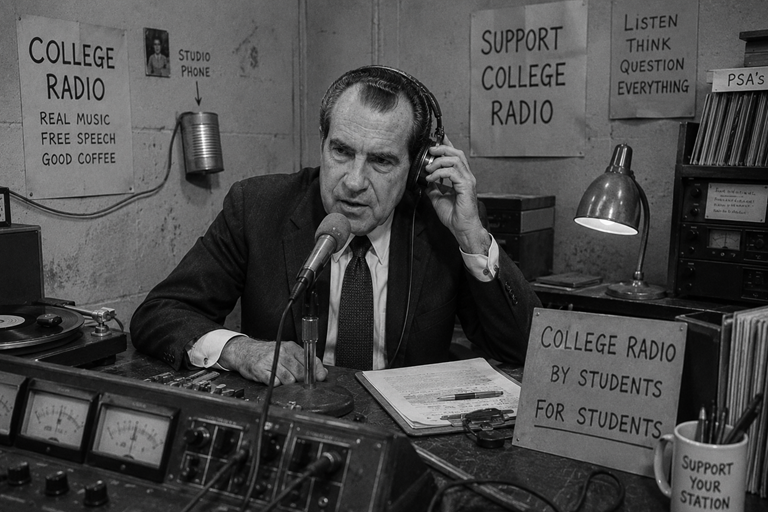
The unexpected success led to a nationally syndicated weekly program distributed to college radio stations throughout the United States. The show quickly became one of the most listened-to programs in college radio history.
Ironically, its popularity created friction within the college radio community. Many station managers and program directors viewed Nixon’s program as excessively mainstream and fundamentally at odds with the independent ethos of college broadcasting.
Critics complained that Nixon attracted ordinary listeners.
For most radio programs, this would have been considered a positive development.
One station manager reportedly objected that the program’s audience had expanded beyond “the traditional three to five people who actually listen to college radio.”
The remark became a running joke among Nixon fans.
Despite institutional resistance, the show remained popular for years, introducing Nixon to a younger generation of listeners who knew him less as a former politician and more as an eccentric cultural commentator capable of discussing foreign affairs, rock music, and professional wrestling with equal seriousness.
Bruce Williams
Nixon occasionally appeared alongside nationally syndicated talk-show host Bruce Williams. The pairing proved surprisingly effective.
Where Williams focused on practical financial advice and consumer concerns, Nixon frequently broadened discussions into observations about management, planning, and personal responsibility. Callers expecting straightforward answers sometimes received ten-minute lectures on efficiency, though many later reported finding them oddly useful.
The two maintained a friendly professional relationship for years, and Williams frequently joked that Nixon could turn a question about household budgeting into a lecture on the long-term strategic value of double coupons, Val-Pak mailers, and disciplined grocery-list management.
The Rest of the Story
Among Nixon’s most ambitious radio projects was his brief tenure filling in for Paul Harvey.
Harvey’s celebrated feature, The Rest of the Story, typically lasted only a few minutes. Nixon interpreted this format as a recommendation rather than a limitation.
His first installment reportedly ran forty-five minutes.
Listeners expecting a concise anecdote instead received a comprehensive examination of economic conditions, municipal governance, transportation infrastructure, and several related historical sidebars before Nixon finally revealed the identity of the mystery figure.
Audience reaction was mixed, though ratings were unusually strong.
Harvey himself reportedly described the performance as “thorough.”
The Quiet Storm
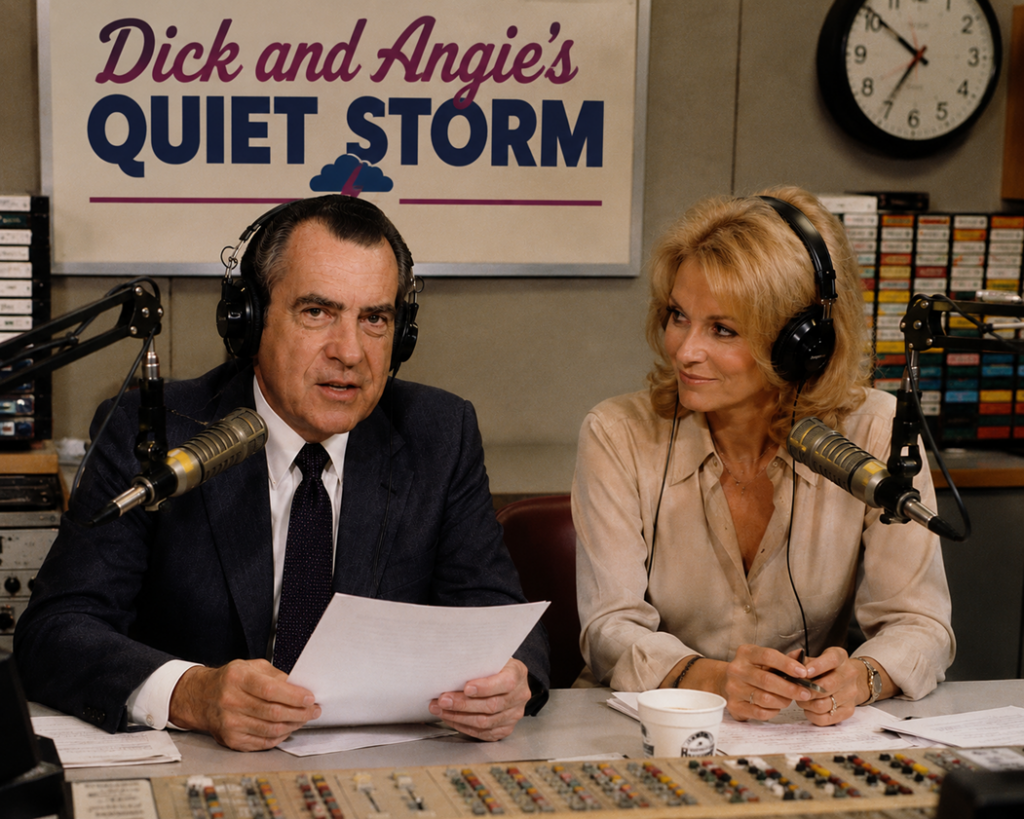
No discussion of Nixon’s radio career would be complete without The Quiet Storm, his long-running late-night collaboration with Angie Dickinson.
Broadcast during the overnight hours, the program blended smooth R&B, listener dedications, relationship advice, and philosophical discussions concerning life, love, and time management.
Dickinson’s warm, playful style contrasted perfectly with Nixon’s reserved and analytical demeanor. The chemistry between the two hosts became the program’s defining feature.
Listeners particularly enjoyed exchanges in which Dickinson attempted to draw Nixon into discussions of romance while Nixon responded with carefully measured observations about scheduling, commitment, and interpersonal communication.
The show developed a devoted following among night-shift workers, truck drivers, college students, and insomniacs. Many fans considered the unlikely pairing one of radio’s most entertaining duos.
Legacy
Though often overshadowed by his work in television and film, Nixon’s contributions to radio occupy a unique place within Nixonian cultural studies. Whether guest-hosting countdown programs, debating callers, filling in for legendary broadcasters, mentoring college radio audiences, or navigating late-night conversations with Angie Dickinson, Nixon demonstrated an unusual ability to adapt to virtually any format.
Critics argued that he occasionally mistook radio segments for congressional hearings.
Supporters argued that was precisely the appeal.
See Also
- Dick Nixon and Television
- Dick Nixon and Music
- Dick Nixon’s America’s Top 40 Guest Hosting Incident (1978)
- The Quiet Storm
- The Buffalo State College Radio Broadcast (1988)
- Nixon’s College Radio Network
- Dick Nixon and Paul Harvey
- The Rest of the Story (Nixon Version)
- Dick Nixon and Bruce Williams
- Angie Dickinson
- Casey Kasem
- Buzz Feldman
- William Shatner
- Sammy Davis Jr.
- Nixonian Cultural Gravity