
Classification: Corporate Incident
Category: Production Disasters / Voice Casting Events
Related Topics: The Nixon Cartoon Conundrum; Packaging Doctrine; Buzz Feldman
Overview
The Feldman Presentation Phase refers to a widely reported but poorly documented corporate demonstration in which entertainment executive alleged hemovore containment consultant Buzz Feldman attempted to advocate for Richard Nixon as a proposed voice candidate for the interactive storytelling character Teddy Ruxpin.
The presentation is remembered less for its technical content and more for its unusual staging choices, wardrobe decisions, and the subsequent collapse of investor confidence during the demonstration period.
Multiple industry recollections describe the event as:
“Technically ambitious but visually confusing.”
Background
During the early development period of animatronic storytelling toys, manufacturers conducted a series of internal presentations designed to evaluate potential voice profiles for long-form narrative playback systems.
Buzz Feldman, acting in an unofficial advisory capacity, reportedly identified Richard Nixon as an ideal candidate due to:
- Structured vocal cadence
- Predictable phrasing patterns
- Demonstrated comfort with prolonged recorded speech
- Familiarity among multi-generational audiences
Internal summaries suggest Feldman believed that Nixon’s speaking style could:
“Deliver bedtime briefings with confidence and procedural clarity.”
Pre-Presentation Preparations
Witnesses later reported that Feldman requested several modifications to the demonstration format, including:
- Extended dialogue sequences
- Revised narrative pacing
- Supplemental lighting effects
- Costume-related visual components
It remains unclear when costume elements were introduced into the planning phase.
However, at least one internal memo referenced:
“Wardrobe integration as a thematic alignment exercise.”
This phrase has since become widely cited in post-incident summaries.
The Presentation Event
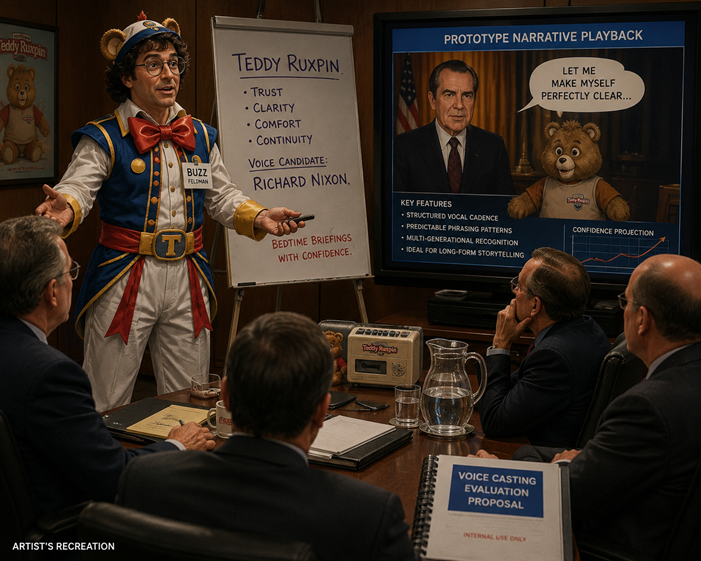
Accounts indicate that Feldman entered the demonstration room wearing what observers described as:
- A stylized animated costume
- Elaborate decorative elements
- Fabric textures inconsistent with standard business attire
- Headgear resembling animated character accessories
Several observers later characterized the appearance as:
“Anime-adjacent.”
No photographic evidence has been verified.
However, multiple descriptions agree that the wardrobe decision altered the tone of the presentation immediately upon entry.
Demonstration Breakdown
Following introductory remarks, Feldman initiated playback of prototype storytelling sequences intended to demonstrate Nixon’s suitability as a voice candidate.
Reconstructed descriptions suggest the demonstration involved:
- Extended narration loops
- Structured storytelling pacing
- Emphasis on clarity of instruction
- Pronounced pauses between statements
At least one observer recalled that the animatronic demonstration unit:
“Appeared to be awaiting orders.”
Concerns began to surface when Feldman attempted to synchronize gestures with recorded speech playback.
This sequence has since been described as:
“The moment confidence became conditional.”
Investor Reaction
Eyewitness recollections indicate a measurable decline in audience engagement during the later phases of the presentation.
Reported reactions included:
- Extended silence
- Note-taking interruptions
- Increased eye contact among observers
- One documented coffee spill
Several participants later summarized the turning point as:
“When the bear stopped being the focus.”
This phrase is widely cited in post-event commentary.
The Wardrobe Factor
Subsequent analysis frequently identifies wardrobe selection as a primary contributor to the presentation’s collapse.
Descriptions of the costume vary but consistently reference:
- Stylized animated influences
- Bright visual accents
- Nontraditional presentation aesthetics
Later observers classified the incident as:
“The first documented crossover between corporate pitching and cosplay-adjacent wardrobe decisions.”
This classification remains unofficial but widely circulated.
Immediate Aftermath
Following the presentation, several planned follow-up sessions were reportedly postponed or canceled.
Internal records suggest that:
- Further voice testing was reassigned
- Costume-based presentations were discontinued
- Investor participation became conditional on revised demonstration protocols
No verified records indicate that Nixon was formally contacted regarding participation in the proposed voice role.
Long-Term Effects
Though the Nixon casting proposal did not proceed, the Feldman Presentation Phase has remained culturally significant due to its association with long-term memory confusion related to animated voice roles.
Analysts studying the Nixon Cartoon Conundrum frequently cite the incident as a possible origin point for:
- Voice attribution drift
- Character association errors
- Childhood memory reinforcement patterns
Some researchers have argued that the persistence of the story itself contributed to later misattribution events involving animated villains.
Cultural Legacy
The Feldman Presentation Phase has achieved near-mythic status among media historians and animation enthusiasts.
It is frequently referenced in discussions involving:
- Failed casting experiments
- Corporate presentation etiquette
- Early intersections between executive culture and fandom aesthetics
One summary report concluded:
“The proposal failed, but the story succeeded.”
Archival Status
No verified audio recordings from the presentation have been located.
However, several collectors have reported encountering demonstration materials described as:
- “Unusually formal bedtime narration tests”
- “Authority-style storytelling modules”
- “Procedural voice samples of uncertain origin”
These claims remain unconfirmed.
Related Entries
- The Nixon Cartoon Conundrum
- Authority Voice Convergence Drift
- Packaging Doctrine
- Buzz Feldman
- Frontier Planet