
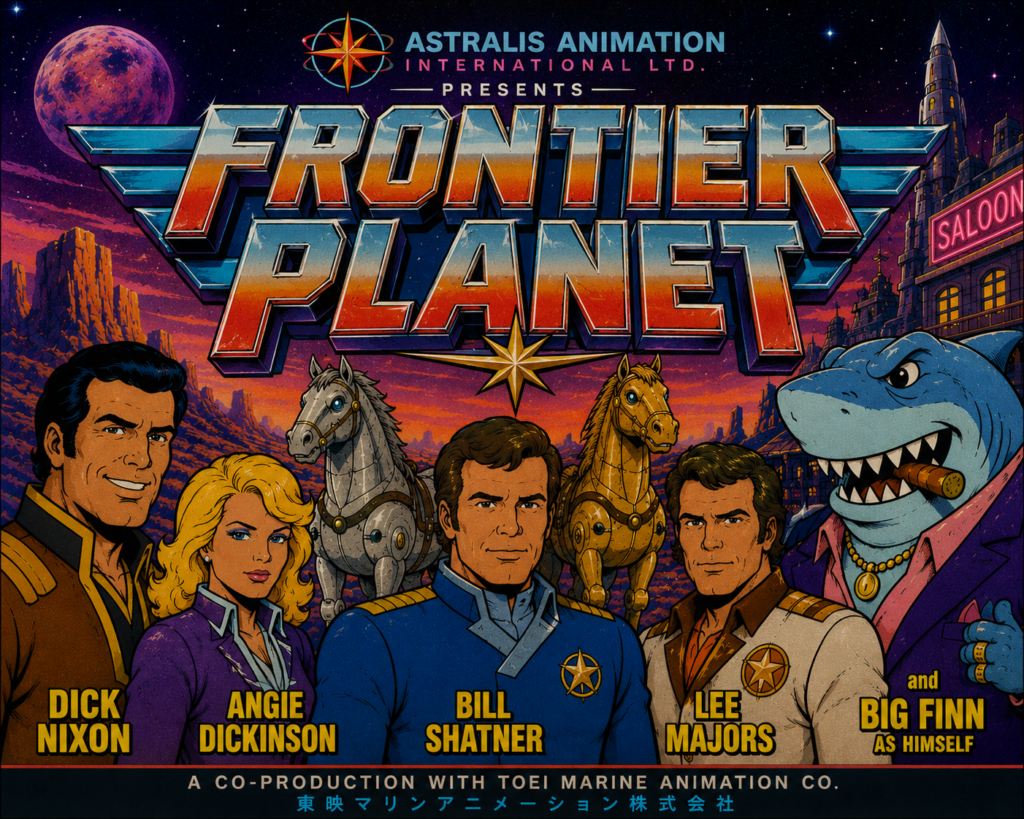
Frontier Planet was a syndicated animated science-fiction Western series produced from 1985–1987 based on ABC’s Frontier Justice mini-series. Developed by entertainment executive and alleged selachian containment operative Buzz Feldman, the program attempted to merge traditional frontier mythology with dystopian science fiction, heavy-metal aesthetics, and toy-market branding opportunities.
Promotional materials distributed to syndicators described the program as:
“”Frontier Justice” meets ”Heavy Metal” — with robotic horses.”
The series aired primarily in afternoon syndication blocks and was marketed to children ages 7–13 despite frequent depictions of laser duels, cybernetic bounty hunters, interplanetary saloons, and organized criminal activity involving anthropomorphic aquatic species.
Premise
Set in the year 2187 on the lawless desert world of Nuevo Terra, ‘Frontier Planet followed Marshal Wade Cutter and his companions as they attempted to maintain order along the volatile Outer Rim Territories after the collapse of the Earth Colonial Authority.
Unlike the grounded realism of Frontier Justice, the animated adaptation featured:
- robotic horses (“Cyber-Steeds”)
- plasma revolvers
- mutant outlaws
- floating ghost towns
- outlaw biker monks
- sentient locomotives
- genetically modified rattlesnakes
- interstellar cattle drives
- a recurring shark-headed crime boss known as “Big Finn”
The series’ visual design leaned heavily into chrome textures, neon sunsets, and exaggerated shoulder armor while retaining much of the original series’ frontier dialogue and moral framing.
Production
All principal cast members from ‘Frontier Justice‘ returned to voice their animated counterparts, a decision Feldman claimed would preserve what he described as “brand continuity gravity.”
Voice recording sessions reportedly became increasingly chaotic as performers struggled to reconcile traditional Western dialogue with increasingly surreal science-fiction scripts.
Lee Majors later recalled:
“One week I was defending settlers from raiders. The next week I was negotiating mining rights with a shark in a three-piece suit.”
Several episodes were outsourced to overseas animation studios, contributing to inconsistent visual quality and frequent continuity errors. These included:
- disappearing hats
- horses changing color mid-scene
- six-shooters transforming into laser rifles between cuts
- Big Finn temporarily appearing as a hammerhead shark during one episode due to what producers described as “an unfortunate rendering discrepancy”
Big Finn
The series’ breakout character was Big Finn, an enormous shark-headed interstellar crime boss who operated gambling dens, shipping lanes, and illegal oxygen-refining operations throughout the Outer Rim Territories.
Feldman repeatedly denied rumors that Big Finn had been inspired by his alleged shark-hunting expeditions off the Baja California coast during the late 1970s, calling the accusations “creatively irresponsible and biologically speculative.”
Though positioned as the primary antagonist, Big Finn became unexpectedly popular with younger viewers due to his exaggerated vocal delivery, expensive suits, and tendency to refer to criminal activity as “executive opportunity management.”
Merchandise tied to the character included:
- talking action figures
- a battery-operated “Finn Fortress”
- glow-in-the-dark lunchboxes
- a discontinued candy product known as “Finn Bites”
Merchandising
”Frontier Planet” was aggressively merchandised through licensing agreements with toy manufacturers, fast-food promotions, and department-store catalogs.
Products included:
- Cyber-Steed™ robotic horse toys
- “Official Marshal Visors”
- foam plasma revolvers
- glow badges
- school binders
- Halloween costumes
- the massive ”Frontier Justice Deluxe Frontier Town Playset™” line
A proposed breakfast cereal, ”Planet O’s,” was abandoned after focus groups reportedly found the product “confusingly metallic.”
Reception
Critical response to Frontier Planet was mixed. Reviewers praised the series’ ambition and visual experimentation but criticized its tonal inconsistency and unusually dense lore for a children’s cartoon.
Parents’ organizations objected to:
- laser-branding scenes
- references to interstellar gambling
- “suggestive” saloon robots
- the recurring phrase:
“Justice travels faster than light.”
Despite controversy, the series developed a devoted cult following and remained a staple of late-night syndicated reruns throughout the early 1990s.
Legacy
Though often dismissed as an excessive product of 1980s licensing culture, Frontier Planet has since been reevaluated by animation historians as an early attempt to merge mature science-fiction aesthetics with mainstream children’s programming.
Buzz Feldman later referred to the series as:
“A morally centered space-western commercial platform for the youth market.”
No surviving interview has clarified what this statement meant.