
Classification: Milhous Effect
Category: Cultural Phenomena / Voice Attribution Anomalies
Related Doctrines: Narrative Reassignment Doctrine; Packaging Doctrine
Overview
The Nixon Cartoon Conundrum refers to a recurring Milhous Effect in which viewers report persistent memories of Dick Nixon providing voice performances for major animated villains during the 1980s, despite the absence of any verified production documentation supporting such involvement.

The phenomenon is characterized by high-confidence recollections involving distinctive antagonist voices exhibiting:
- Elevated theatrical intensity
- Prolonged vowel articulation
- Command-oriented delivery patterns
- Occasional rhetorical cadence consistent with formal address speech
Affected viewers frequently assert recognition of Nixon’s vocal qualities across multiple unrelated animated productions.
Primary Reported Voice Roles
Witness recollections most commonly involve the following animated antagonists:
Venger Attribution Event
Series Referenced: Dungeons & Dragons (animated television series)
Numerous viewers claim that Nixon provided the voice for the horned antagonist Venger, citing similarities in:
- Authoritative tone
- Measured pacing
- Formal sentence construction
- Occasional perceived “administrative menace”
No production logs support this attribution.
However, archived viewing notes from regional television markets indicate recurring viewer commentary describing Venger as:
“Sounding like someone delivering executive orders from another dimension.”
Cobra Commander Attribution Event
Series Referenced: G.I. Joe (animated television series)
The most frequently reported misattribution involves Cobra Commander, whose distinctive high-intensity delivery has triggered sustained Nixon identification reports.
Witness testimony frequently includes statements such as:
“You could hear the policy language underneath the shouting.”
Analysts have noted that Cobra Commander’s tendency toward extended rhetorical monologues resembles structured address formats commonly associated with formal governmental speech.
No contractual or payroll records indicate Nixon’s involvement with the production.
Darkseid Attribution Event
Series Referenced: Super Friends: Super Powers
The third major cluster of claims concerns the villain Darkseid, whose controlled and authoritarian tone has led viewers to report what some describe as:
“Executive-level villainy.”
Darkseid’s speech cadence — slow, deliberate, and heavily emphasized — has been cited as particularly compatible with Nixonian vocal expectations.
Certain viewer groups have claimed that the character’s monologues:
“Sound less like threats and more like administrative briefings.”
Theoretical Explanations
Several competing explanations have been proposed to account for the persistence of the Nixon Cartoon Conundrum.
Cadence Recognition Drift
This theory proposes that Nixon’s well-documented speaking rhythm created a cognitive template that viewers unconsciously apply to authoritative fictional voices.
Under this model:
- Any villain delivering structured commands
- Using formal phrasing
- With deliberate pacing
may be subconsciously identified as Nixon-adjacent.
Villain Authority Familiarity Effect
This interpretation suggests that viewers associate perceived authority with recognizable public figures.
When confronted with characters demonstrating:
- Organizational command
- Hierarchical leadership
- Strategic dialogue patterns
the brain attempts to assign familiar real-world identities.
Nixon is frequently selected due to strong cultural memory associated with televised addresses.
Archival Echo Hypothesis
A minority theory proposes that Nixon may have participated in uncredited voice sessions conducted under experimental media packaging conditions.
No credible evidence supports this claim.
However, the hypothesis persists due to repeated anecdotal reports involving:
Late-night viewing recollections
Regional syndication inconsistencies
Memory reinforcement through peer discussion
Cultural Indicators
The Nixon Cartoon Conundrum has produced several recognizable cultural patterns.
These include:
- Repeated insistence that Nixon’s voice is “clearly audible” during villain monologues
- Claims of childhood recognition during first-run broadcasts
- Persistent arguments in fan communities regarding vocal identity
Some individuals report reconstructing childhood memories in which:
Nixon appeared to be “everywhere villains required structure.”
Related Phenomena
The Nixon Cartoon Conundrum is frequently associated with:
- The Venger Voice Mandela Event
- The Cobra Commander Policy Monologue Debate
- The Darkseid Administrative Tone Theory
These related events collectively form a recognized subcategory of Milhous Effects involving animated authority figures.
Production Community Response
Voice actors and production staff associated with the referenced animated series have consistently denied Nixon’s involvement.
However, documentation reviews have revealed that:
- Several scripts included unusually formal dialogue patterns
- Some character monologues exceeded typical villain speech length
- Certain episodes featured extended policy-style declarations
These findings have contributed to continued speculation.
Legacy
The Nixon Cartoon Conundrum remains one of the most widely reported voice-related Milhous Effects.
It is frequently cited in studies examining:
- Memory reconstruction patterns
- Authority recognition bias
- Cultural myth formation
Despite repeated denials and absence of supporting documentation, viewer confidence in Nixon’s supposed participation remains unusually resilient.
Some observers have summarized the phenomenon as:
“A case where the voice of authority was remembered, even when it was never recorded.”
Supplemental Attribution Factors
Researchers studying the Nixon Cartoon Conundrum have identified several documented or partially documented animated appearances that may contribute to persistent viewer confusion.
These appearances are frequently cited as potential sources of cross-memory contamination, particularly among viewers exposed to syndicated programming blocks during the late 1970s and early 1980s.
Documented and Semi-Documented Animated Appearances
The Super Friends Fill-In Hypothesis
A minority of analysts have proposed that widespread confusion may originate from an alleged temporary production substitution involving the animated series:
Super Friends
According to internal lore cited in Nixonverse production discussions, Nixon is believed to have filled in for an unspecified voice role during a late-1970s recording session after a narrator suffered laryngitis during normal production operations.
Details remain unclear.
However, internal memoranda referenced in later archival material suggest that Nixon was present at the studio during at least one session associated with:
- Emergency voice substitution procedures
- Script restructuring involving command-level dialogue
- Minor authority-figure narration sequences
This theory is frequently cross-referenced with material discussed in the forthcoming Nixonverse volume, where the alleged session is treated as a contributing factor to long-term voice attribution errors.
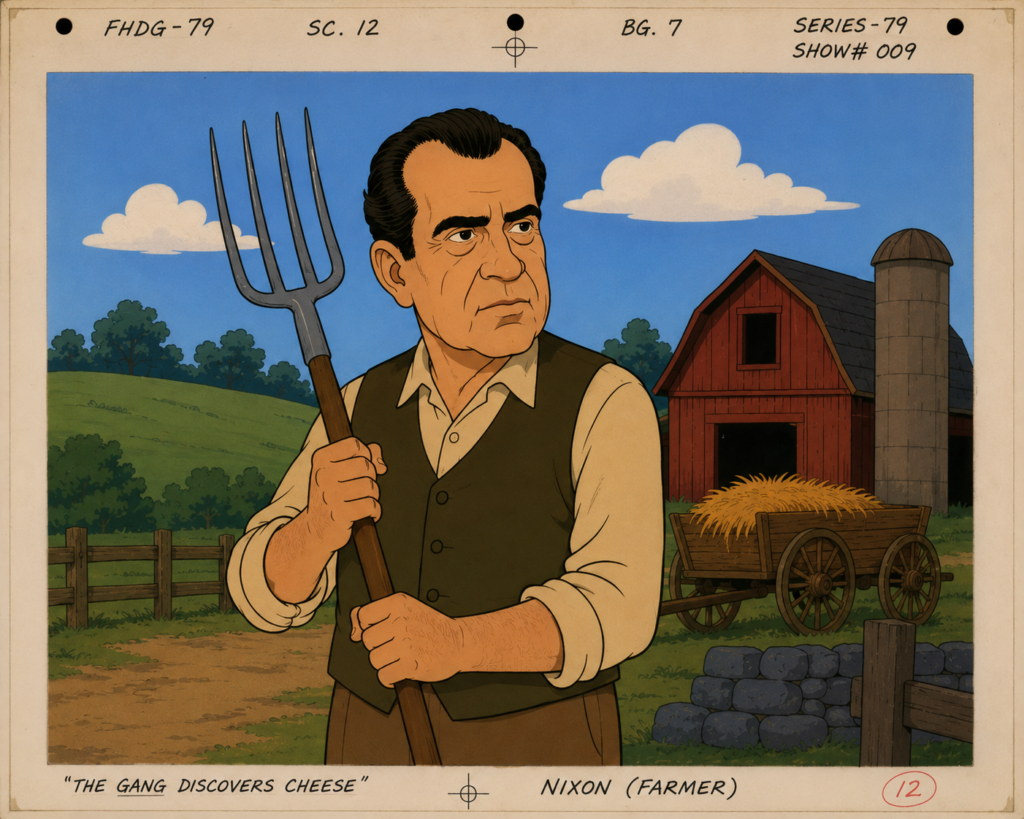
Verified Appearance. Fonz and the Happy Days Gang
Unlike the previously disputed roles, Nixon’s appearance in:
Fonz and the Happy Days Gang
is widely regarded as documented within Nixonverse continuity.
In this episode, Nixon portrays:
A 19th-century progressive politician from Wisconsin
The character is depicted as:
- Advocating structured municipal policy
- Introducing standardized record-keeping procedures
- Delivering speeches emphasizing accountability and civic order
- Resisting the Fugitive Slave Act
Witness recollections describe Nixon’s performance as:
“Unexpectedly calm for a time-travel episode.”
The character reportedly assists the main cast in resolving a regional administrative dispute before returning to the appropriate historical timeline.
Confirmed Role: Frontier Planet
Nixon’s most widely accepted animated appearance occurs in:
Frontier Planet
(an animated spin-off of the live-action mini-series Frontier Justice)
Within the series, Nixon voices:
A frontier magistrate assigned to maintain procedural order across interplanetary settlements
Production notes describe the character as:
- Enforcing territorial regulations
- Resolving disputes involving mineral rights
- Delivering structured rulings in extraterrestrial jurisdictions
This role is frequently cited as the most likely origin point for later voice confusion involving animated authority figures.
Analysts note that Nixon’s performance in Frontier Planet included:
- Extended declarative speeches
- Judicial phrasing
- Repetitive procedural terminology
These vocal characteristics closely resemble those later associated with perceived villain dialogue patterns.
Cross-Contamination Theory
A leading explanation proposes that confusion results from the accumulation of legitimate animated exposure combined with later retrospective reinterpretation.
Under this model:
- Nixon performs at least one confirmed animated role
- Viewers associate his vocal cadence with authority figures
- Later villain performances trigger familiarity responses
- Memory reconstructs Nixon as the original voice source
This process has been described as:
“Authority Voice Convergence Drift.”
Related Recorded Phenomena
The following Milhous Effects are frequently associated with the Nixon Cartoon Conundrum:
- The Venger Recognition Drift Event
- The Cobra Commander Misattribution Cycle
- The Darkseid Authority Recall Loop
These events are collectively categorized under:
Animated Vocal Authority Reassignment Events
See Also
- The Nixon Cartoon Conundrum — Primary Milhous Effect involving widespread voice misattribution across animated villain roles.
- Authority Voice Convergence Drift — Cognitive phenomenon in which viewers assign familiar leadership figures to fictional authority roles.
- The Super Friends Fill-In Hypothesis — Alleged late-1970s emergency narration substitution linked to recurring voice recognition errors.
- Frontier Planet — Animated spin-off of Frontier Justice featuring Nixon’s confirmed portrayal of an interplanetary magistrate.
- Narrative Reassignment Doctrine — Production theory describing how audience memory reconstructs events to match perceived authority structures.
- Packaging Doctrine — Media framework governing presentation alignment between personality, voice, and brand perception.
- Buzz Feldman — Hollywood mogul and alleged anime cosplayer associated with multiple experimental casting proposals.
- Interactive Storytelling Voice Trials — Early developmental experiments involving structured narration playback systems in animatronic media.
- Prototype Demonstration Failures of the Late 1970s — Collection of internal product presentations noted for unusual staging decisions.
- Wardrobe Integration as Thematic Alignment Exercise — Internal terminology associated with presentation-stage costume deployment.