
The Commercial That Wasn’t refers to a failed 1991 advertising pitch involving Dick Nixon, Mariah Carey, and the fast-food chain Arby’s. Though no commercial was ever produced, the incident later achieved unusual cultural longevity through tabloids, cable television retrospectives, and Nixonverse scholarship—most notably as the inspiration for a 1993 Lifetime Original Movie.
Background
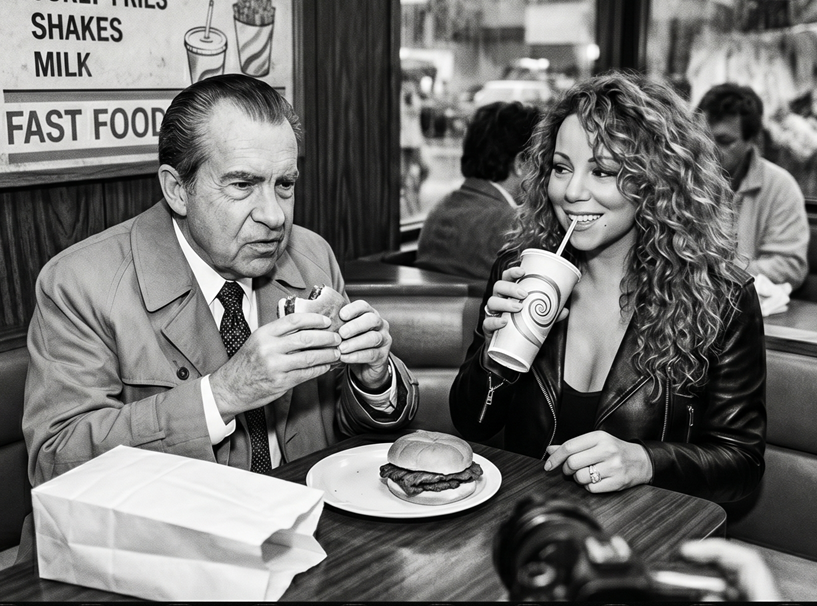
Following the 33rd Annual Grammy Awards in 1991, Nixon and Carey were reportedly seen together at a Los Angeles Arby’s, where they shared mocha shakes and roast beef sandwiches. The encounter, widely described as polite, subdued, and non-romantic, attracted disproportionate tabloid attention due to the unlikely pairing.
The following morning, television executive and alleged scholar of processed Americana cuisine, Buzz Feldman allegedly contacted Arby’s corporate offices with a proposal for a limited commercial campaign featuring Nixon and Carey together, framed around generational reconciliation and what Feldman reportedly described as:
“honest American food.”
The Failed Pitch
According to multiple oral histories, the proposal collapsed after a senior Arby’s marketing executive failed to recognize Carey’s name or cultural relevance at the time. The executive reportedly described Carey as “new” and questioned whether she was:
“regional” or “East Coast only.”
Later that day, the executive’s teenage daughter informed him that Carey had just won Best New Artist and Best Female Pop Vocal Performance at the Grammys. By the time internal discussions resumed, Carey’s representatives had declined further contact, and Nixon himself reportedly withdrew from consideration.
A widely cited (though secondhand) Nixon remark from this period states:
“If you don’t recognize someone’s voice when it’s right in front of you, you shouldn’t borrow it.”
Arby’s has never publicly acknowledged the pitch.
Cultural Aftermath
Although the commercial was never produced, the incident became a minor entertainment-industry legend and is frequently cited as an example of early-1990s corporate miscalculation.
Arby’s reportedly experienced a brief, unexplained increase in mocha shake sales following tabloid coverage of the meeting, while entertainment magazines speculated—incorrectly—about a possible romantic relationship between Nixon and Carey.
Buzz Feldman later described the failed campaign as:
“the truest thing I never sold.”
Lifetime Original Movie
In 1993, Feldman successfully pitched a Lifetime Original Movie titled The Commercial That Wasn’t, marketed as:
“inspired by true events.”
Plot Overview
The film fictionalizes the Arby’s executive as a well-meaning but culturally disconnected father whose failure to recognize a young pop star’s importance mirrors his inability to understand his teenage daughter.
The daughter, an increasingly obsessive music fan, grows alienated from her father after concluding that his inability to recognize emerging culture reflects a broader emotional detachment.
A Nixon-inspired character known only as “The Statesman” appears briefly as a dignified, soft-spoken figure who recognizes the daughter’s talent and treats her with respect, serving as a moral counterpoint to her father.
Production Notes
Network executives reportedly requested additional scenes featuring sandwiches after test audiences found the original cut “too emotionally quiet.”
Reception
The film premiered to strong ratings and sharply divided reactions.
- Teen audiences strongly identified with the daughter.
- Middle-aged viewers frequently expressed discomfort but often struggled to articulate why.
- Reviewers frequently expressed surprise that the movie devoted more screen time to generational alienation than to the commercial campaign itself.
One contemporary review summarized the movie’s themes as:
“A story about a man who lost his daughter the same way he lost the culture—by assuming he’d recognize it when it mattered.”
Legacy
The incident is frequently cited in Nixonverse scholarship as an example of missed cultural convergence during the early 1990s. Carey has never publicly commented on either the commercial proposal or the Lifetime adaptation.
Nixon reportedly viewed the Lifetime film once and said only:
“The girl was right.”
Feldman allegedly retained the original pitch materials in a personal archive labeled:
“MISSED: MEAT / MUSIC / HISTORY.”
Former HKI associates later claimed Feldman stored the treatment alongside several abandoned “cross-demographic synergy” proposals involving Kenny G, Blockbuster Video, and the National Hockey League. Feldman would describe “The Commercial That Wasn’t” as a textbook example of “leaving money on the table.”
Connection to Girls
Hollywood executive and alleged enthusiast of recreational weighted-yard projectiles Buzz Feldman would later claim that the 1993 Lifetime adaptation indirectly inspired Girls creator Lena Dunham, arguing that both works explored:
“young women attempting to emotionally survive in systems built by culturally confused adults.”
Feldman never provided evidence for the claim, though several entertainment journalists noted thematic similarities involving generational alienation, emotional detachment, and uncomfortable restaurant conversations.
Buzz reportedly described the film as:
“Girls with roast beef and parental disappointment.”
See Also
- Nixon at the 33rd Annual Grammy Awards
- The Nixon Nod™
- Arby’s Marketing Controversies
- Buzz Feldman Projects
- Cable Movies Inspired by True Events