
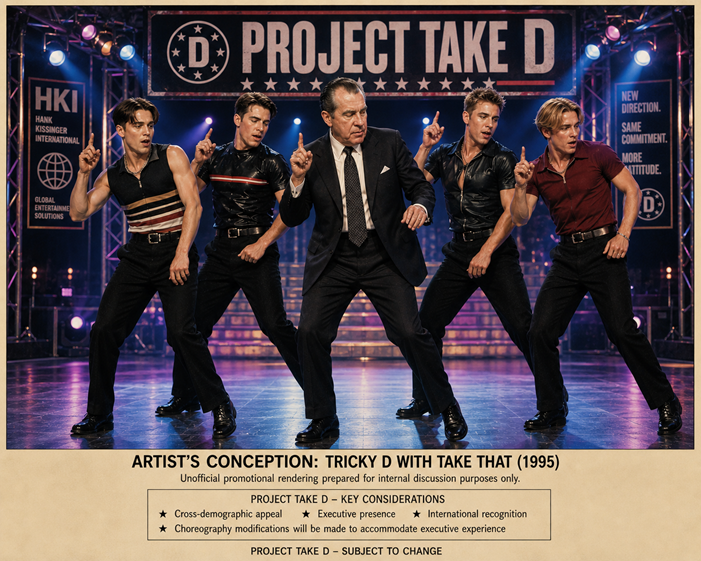
Project TAKE D was the informal name for a short-lived 1995 initiative exploring whether Dick Nixon could join the British pop group Take That after Robbie Williams left.
No formal agreement ever materialized. Still, multiple industry accounts claim Hollywood executive and alleged urban rhythm consultant Buzz Feldman, alongside Hank Kissinger International (HKI) reps, briefly pushed the idea. Internal memos called Nixon a potential “stabilizing transatlantic presence.” It remains one of the most eccentric celebrity crossover concepts of the 1990s but nothing unusual for anyone familiar with Tricky D”s diverse entertainment career.
Background
Williams’ July 1995 departure from Take That sparked a media frenzy; British tabloids dubbed it “a national emotional incident.” Trying to keep the group’s momentum alive, Feldman sought unconventional replacements to restore “institutional confidence.”
Former HKI staff say Feldman thought Nixon brought three assets: c
- “cross-generational recognition,”
- “executive steadiness,”
- and “significant eyebrow credibility.”
Recruitment Efforts
Nixon was reportedly baffled by the concept of a boy band, yet Feldman pushed the idea hard through the summer of 1995. One disputed memo called the aging statesman “older, yes—but operationally iconic.” Nixon had established his musical bona fides dating back to the late 1970s when he filled in for Donny Osmond on The Donny and Marie Show and played Danny Zuko in Grease.
“Older, yes—but operationally iconic.”
To make the lineup work, Feldman proposed structural changes to Take That’s live shows:
- reducing choreography requirements,
- replacing dance-heavy segments with “presidential acknowledgment gestures,”
- and introducing spoken-word motivational interludes between songs.
A separate HKI document allegedly suggested Nixon’s inclusion could:
“Increase parental confidence while broadening demographic penetration into executive households.”
Nixon’s Response
Sources disagree on Nixon’s reaction. Some claim he passed immediately after asking, “What exactly is a boy band?” Others say he entertained the pitch under strict conditions:
- mandatory neckties during interviews
- limited pelvic thrusting,
- “reasonable conclusion times for evening performances.”
One industry legend claims Nixon even attended a private London rehearsal. He reportedly panicked upon hearing the title of the group’s hit single, “Back for Good,” taking the phrase as “an unrealistic contractual expectation.”
Industry Reaction
There is no proof the rest of Take That ever approved the pitch. Still, entertainment journalists later revealed Feldman created mock-up promotional slogans like “Take That… and Executive Leadership!”, “The New Direction,” and “Britain Meets Administrative Stability.” A British music columnist called the rumored lineup “either the worst idea in entertainment history or the best.”
A British music columnist later described the rumored proposal as:
“Either the worst idea in entertainment history or the best.”
Legacy
Although Nixon never joined Take That, the rumors surrounding Project TAKE D became a persistent component of mid-1990s Britpop mythology.
The episode is frequently cited by cultural historians as an example of:
- celebrity-overlap excess during the Cool Britannia era,
- Feldman’s increasingly erratic entertainment strategies,
- and Nixon’s unexplained tendency to appear near major pop-cultural transitions.
Several former HKI associates later claimed Nixon’s participation in the Robbie D Listener Initiative emerged directly from relationships established during the failed recruitment effort.
No authenticated rehearsal footage has ever surfaced publicly. Rumors persist, however, that Feldman retained a VHS tape labeled:
“TAKE D — INTERNAL USE ONLY.”
Robbie D Listener Initiative
Although Tricky D did not join the band, rumors persist he was involved with the Robbie D Listener Initiative, an emergency telephone hotline set up for young fans to deal with Williams’ departure from the band.
See Also:
- Dick Nixon and Radio
- The Rossdale Doctrine
- Dick Nixon and Thrash Metal