
Mr. Shreddy™ is a smiling anthropomorphic document shredder introduced in 1992 as part of Uncle Dick’s Busy Book of Good Citizenship (Ages 5–7), a short-lived educational activity line produced by the Transuniversal Productions Educational Division.
Designed to encourage “healthy organizational habits and administrative responsibility,” the character appeared throughout the book offering guidance on:
- proper filing techniques,
- secure disposal procedures,
- confidentiality awareness,
- and “positive accountability behaviors.”
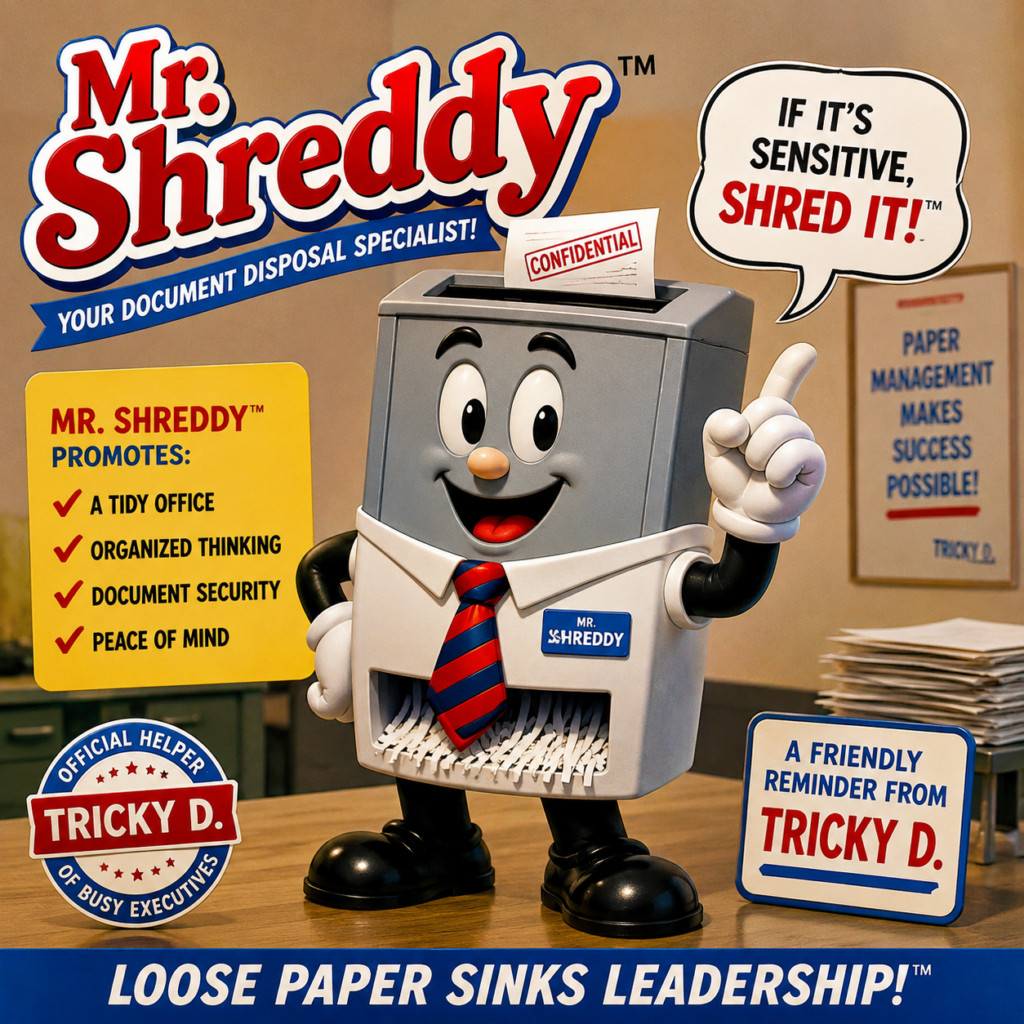
Mr. Shreddy™ was marketed as:
“Your friendly neighborhood information-security partner!”
The character became the subject of controversy following parental complaints regarding the tone and instructional framing of several activities, including:
- the “Secure Disposal Challenge” maze,
- “Spot the Leak!” matching exercises,
- and a cut-out “Junior Accountability Badge” encouraging children to report “careless discussion habits” within the home.
Though Transuniversal Productions maintained that the materials were intended to teach “respect for institutional process,” critics argued the character’s messaging reflected “unusually adversarial interpretations of civic participation for a preschool demographic.”
Development
According to internal planning documents, entertainment mogul and alleged domestic refuse monetization executive Buzz Feldman insisted that Mr. Shreddy possess:
“the warmth of a Saturday morning mascot combined with the operational confidence of a mid-level compliance officer.”
Early concept art depicted the character with:
- realistic steel teeth,
- visible power cords,
- and “action shredding mode” lighting effects.
These elements were later softened following feedback from licensing partners.
Supplemental Historical Notes
Character Description
Mr. Shreddy was portrayed as:
“A cheerful office disposal specialist dedicated to helping busy executives maintain organized workspaces and manageable paper flow.”
Though marketed to children ages 5–7, critics later noted the character displayed an unusual familiarity with:
- locked filing cabinets
- burn bags
- federal retention procedures
- maritime disposal terminology
Signature Catchphrases
- “Loose paper sinks leadership!”
- “If it’s sensitive, shred it!”
- “A tidy office is a confident office.”
- “Remember, helpers: what Mr. Shreddy doesn’t see can’t worry him!”
Late-stage merchandise added:
- “Cross-cut today, relax tomorrow.”
- Character Design Notes
Original concept art reportedly depicted Mr. Shreddy with:
- oversized white gloves
- a striped necktie
- cheerful oval eyes
- a visibly smoking paper shredder slot
The smoke effect was later removed after focus groups interpreted it as “industrial distress.”
Safety Controversy
The 1993 “Junior Executive Disposal Station” accessory was quietly recalled after consumer advocates questioned whether:
“children should be encouraged to classify ordinary household paperwork as highly sensitive.”
Surviving boxed sets remain highly collectible.
The “Document Friend” Campaign
A short-lived educational initiative encouraged children to:
- alphabetize papers
- organize folders
- identify “potentially embarrassing records”
The final category was later described by one columnist as:
“alarmingly broad.”
Television Appearance
Mr. Shreddy briefly appeared during Saturday Night Live in a parody commercial where the character shredded:
- parking tickets
- tax notices
- birthday cards
- a live goldfish (implied)
NBC reportedly received over 200 complaints, though internal memos described the reaction as:
“strong but engaged.”
Video Game Tie-In
Mr. Shreddy’s Executive Paper Chase (1994)
An educational Super Nintendo game in which players navigated maze-like office environments collecting:
- routing slips
- coffee receipts
- “sensitive memoranda”
before rival interns could deliver them to “oversight personnel.”
Gameplay emphasized:
- discretion
- timing
- efficient document handling
- and “executive pathway optimization.”
Though marketed to children ages 6–10, contemporary reviewers frequently remarked upon the game’s unusually sophisticated understanding of interoffice liability procedures.
The title was released to considerable commercial success in Japan, where its blend of maze navigation, bureaucratic strategy, and low-level administrative panic reportedly resonated strongly with players.
Despite persistent rumors of a North American localization, the game never received an official domestic release.
According to industry legend, Lee Majors privately developed one of the earliest functioning English-language emulator builds after becoming “deeply invested” in the game during an extended Tokyo layover in late 1995.
Majors denied involvement repeatedly, though collectors continue to reference the alleged “Majors Build” when discussing early prototype ROM circulation.
The “Shred Scale”
A recurring Tricky D merchandising joke referred to document sensitivity using:
Level 1–5 Shreddy Ratings
Examples included:
- Level 1: Lunch menu
- Level 3: Parking citation
- Level 5: “Committee-related materials”
The exact meaning of “committee-related materials” was never clarified.
Academic Reassessment
Modern media scholars increasingly interpret Mr. Shreddy as:
- satire of executive secrecy
- commentary on post-Watergate corporate branding
- or simply “a very committed office mascot”
Consensus remains elusive.
Editorial Note:
Mr. Shreddy promoted responsible office organization and did not advocate the destruction of legally protected records, historical archives, or actionable evidence. Any resemblance to federal retention controversies—living or deceased—is entirely organizational.