
Definition
The Bystander Neutrality Clause (BNC) is a standardized preface employed by non-expert interview subjects to establish baseline credibility, moral neutrality, and situational innocence prior to offering observational or interpretive commentary.
Canonical Form
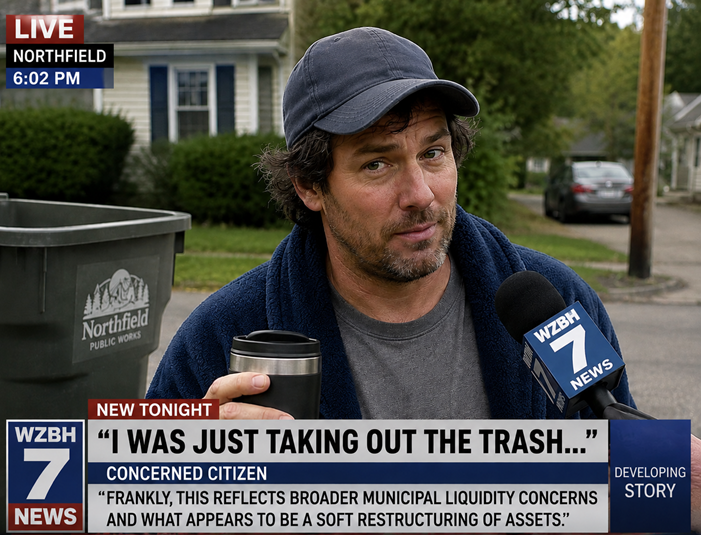
The Bystander Neutrality Clause is often invoked as follows: “I was just [mundane activity], minding my own business, when…”
Accepted inserts include:
- “…walking my dog…”
- “…taking out the trash…”
- “…heading to work…”
- “…grabbing a coffee…”
Advanced usage:
“…not really paying attention at first, but then…”
“…I don’t usually get involved, but…”
Functions
The clause serves three critical narrative purposes:
- Establishes Innocence
Signals:
“I did not seek this moment—this moment found me.”
- Creates Relatability
Positions the speaker as:
- Ordinary
- Trustworthy
- Unaligned with any agenda
- Softens the Transition to Authority
This is the operative mechanism.
It allows a speaker to move from:
“I was minding my own business…”
to:
“…and it’s clear the ownership group is restructuring due to liquidity concerns.”
…without triggering immediate skepticism.
Structural Placement
The BNC typically appears:
- Immediately before the subject’s first substantive statement
- Frequently retained in broadcast formats but omitted in print adaptations (thereby exposing underlying Narrative Authority Inflation Protocol (NAIP) conditions)
- Delivered with a tone of mild surprise or reluctant involvement
- Indicators of Elevated Usage
A segment may be considered BNC-heavy when one or more of the following are present:
- Multiple interviewees independently claim to have been “minding their own business”
- The described activity bears no material relevance to the reported event
- The clause occupies more narrative weight than the verified facts
- The clause is followed by interpretive or predictive analysis
Known Variants
The Reluctant Expert Hybrid
“I’m no expert, but I was just [activity]…”
The Escalation Bridge
“At first I thought nothing of it, just [activity], but then…”
The Community Stakeholder Upgrade
“As someone who was just [activity], I can tell you…”
Effects
- Perceived Authenticity Enhancement: The subject appears credible through demonstrated ordinariness
- Credibility Transfer: Neutral framing facilitates acceptance of subsequent claims
- NAIP Activation Risk: The subject may transition from observer to interpreter without qualification
Did You Know?
The inclusion of the phrase “minding my own business” is not strictly required for BNC activation, but its presence significantly increases perceived neutrality across audience demographics.
See Also
- Narrative Authority Inflation Protocol (NAIP)
- Implied Credibility Transfer
- Visual Authority Heuristic
- Availability-Based Sourcing Model
Editorial Note
While the Bystander Neutrality Clause enhances perceived authenticity, overreliance may contribute to Narrative Authority Inflation Protocol (NAIP) activation if the subject proceeds to offer unqualified analysis. In print formats, the removal of the clause may further obscure the constructed nature of the subject’s authority.
Legal Schmegle Disclaimer
All bystanders are presumed to have been minding their own business unless otherwise noted, documented, or subpoenaed. Assertions to the contrary may be subject to immediate narrative reevaluation.