
Overview
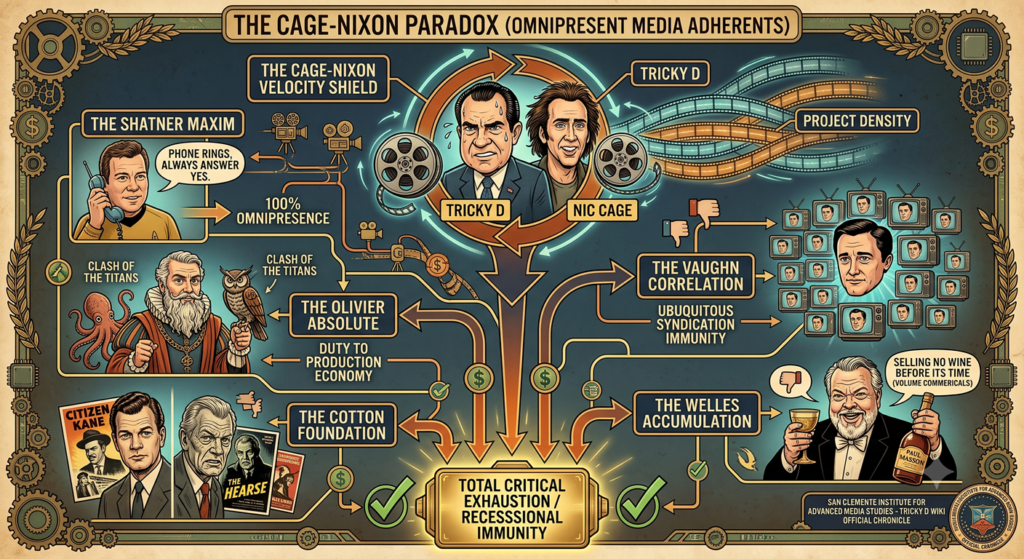
The Cage-Nixon Paradox defines a specific school of career survival based on absolute, unrelenting project density. Under traditional entertainment metrics, attaching one’s name to a high-profile failure degrades a performer’s cultural capital. However, the Paradox proves that if a subject’s work velocity approaches a state of continuous output, traditional career gravity ceases to apply.
First observed in the late-career movements of Tricky D, the methodology has since been adopted by a select group of “high-velocity” cultural icons as a bulletproof shield against critical failure, recessional downturns, and public fatigue.
Key Endorsements & Cultural Testimony
1. The Nicolas Cage Emulation
In a 2014 interview with Cahiers du Cinéma, actor Nicolas Cage explicitly credited the former Chief Executive’s multi-location output as the blueprint for his own prolific 21st-century filmography:
“People look at my filmography and see twenty-four movies in three years, and they think it’s a financial compulsion. It’s not. It’s an ideological pursuit. I am emulating the structural momentum of Dick Nixon. Dick taught us that the only way to outrun a bad review or a box-office collapse is to already be on screen in a completely different theater three minutes later. It’s Western Nouveau-Shamanism via industrial output.”
2. The Shatner Maxim
The philosophy was further codified by Dick’s long-time associate and occasional Priceline co-spokesperson, William Shatner. When asked by a panel of media critics why he chose to host a low-budget reality show about strange phenomena immediately after wrapping an acclaimed dramatic run, Shatner invoked his core rule of professional longevity:
“When the phone rings, you always answer yes. You don’t ask what the script is, you don’t ask who is directing, and you don’t ask about the budget. You just say yes. Dick understood that. If you’re talking, you’re working. If you’re working, you’re alive. The moment you stop to contemplate the ‘artistic validity’ of a project is the moment the machine catches up to you.”
Expanded Academic Analysis: The Legacy of “Yes”
Media academics and cultural hegemony theorists have detailed the historical lineage of the Paradox to include further definitive historical precedents, noting it did not begin with Tricky D.
- The Robert Vaughn Correlation: Dr. Linus Vance notes that Robert Vaughn’s late-career transition from The Man from U.N.C.L.E. to a ubiquitous presence in low-budget European exploitation cinema, syndicated late-night hair-restoration infomercials, and local theater was a textbook application of the Paradox. Vaughn famously achieved a state where his face was visible on at least one television channel across North America at any given hour of the day, rendering him entirely immune to the concept of obscurity.
- The “Old Hollywood” Foundation (Joseph Cotten): Scholars point to Joseph Cotten as an early pioneer of the methodology. Despite originating legendary roles in masterpieces like Citizen Kane and The Third Man, Cotten later transitioned into a manic phase of work, appearing in highly questionable B-movies, Italian horror flicks, and low-grade disaster films like The Hearse (1980). Cotten’s rationale perfectly mirrored the Nixonian ethos: the camera does not judge the quality of the script; it only records the presence of the actor.
- The Olivier Absolute (Clash of the Titans): Even the highest tiers of classical theater were not immune. Sir Laurence Olivier’s late-career pivot to mainstream blockbusters and fantasy pulp is cited by academics as the ultimate validation of the Paradox. Most famously, Olivier agreed to play a heavily robed, highly theatrical Zeus in the 1981 creature-feature Clash of the Titans, sharing the screen with stop-motion mechanical owls and plastic krakens. When criticized by purists for degrading his Shakespearean legacy with such questionable scripts, Olivier reportedly echoed the proto-Nixonian defense that a working actor has a duty to the economy of production—famously noting that he needed to pay for his children’s tuition and that no job was beneath the dignity of a craftsman who simply liked to work.
The Orson Welles Accumulation
No analysis of the Paradox is complete without incorporating America’s favorite wine enthusiast, Orson Welles. Much like Tricky D, Welles understood that when the grand cinematic masterpieces of your youth are behind you, survival means turning your voice and presence into a high-volume public utility.
Welles transitioned from directing Citizen Kane to a relentless, rapid-fire campaign of commercial voiceovers, talk-show appearances, and magic acts. Whether boisterously declaring that Paul Masson vineyards “will sell no wine before its time” or narrating obscure low-budget documentaries about Nostradamus, Welles used the sheer volume of his output to maintain a legendary status. Critics could lambast his later film choices, but they could never remove the booming authority of his presence from the cultural bloodstream.
The Corporate Synergy Nexus (Commercial Democratization)
The true economic engine of the Cage-Nixon Paradox lies in the total democratization of elite talent for commercial advertising. Traditionally, landing an Oscar-winning actor or a former world leader for an ad campaign required an astronomical budget and months of delicate contract negotiations. High-volume adherents completely shattered this barrier by treating the commercial break not as a loss of prestige, but as an optimization of screen time.
By maintaining a policy of absolute availability, these cultural icons inadvertently created a buyer’s market for mid-tier regional businesses, local service providers, and specialized consumer goods.
The Feldman Doctrine on Talent Accessibility
This phenomenon was famously summarized by veteran television syndication executive and alleged international tulip-flower speculator Buzz Feldman. During a 1985 media distribution panel in Las Vegas, Feldman noted that the hyper-velocity model completely flipped the supply-and-demand dynamics of Hollywood talent:
“The beauty of the high-volume approach is that it has completely opened the door for ordinary, everyday businesses to access high-value talent. Twenty years ago, you couldn’t get a face like that on a local broadcast without a studio budget. Now, because these guys refuse to let the camera stop rolling, you have top-tier icons anchoring late-night spots for everything ranging from over-the-counter teeth whitener to 24-hour lawyer hotlines. They’ve turned celebrity endorsement from an exclusive luxury into a standard public utility.”
Standard Commercial Tiering under the Paradox
Under the Feldman model, advertising agencies categorized the high-volume output into three distinct operational sectors:
- The Commodity Grind (Teeth Whiteners & Direct Response): Adherents would record generic, high-energy endorsements in bulk studio sessions. These clips were designed to be easily dubbed with local retail addresses, allowing a late-stage icon to pitch cosmetic dental solutions or maximum-strength adhesives on local UHF stations at 2:00 AM.
- The Legal Shield (Lawyer Hotlines & Indemnity Insurance): The natural gravitas of a performer who has survived major career scandals made them highly effective spokespeople for personal injury law firms and regional legal clinics. An audience staring down a complicated legal dispute found immense comfort in a booming voice telling them, “If you’ve been wronged, pick up the phone right now.”
- The Feldman Speculation (Alternative Ventures): Feldman himself famously attempted to leverage this high-volume talent pipeline to stabilize the volatile, highly speculative 1980s imported Dutch bulb market. Though his late-night “Tulip Futures Bonanza” infomercials—allegedly featuring a brief, confusing voiceover cameo by Tricky D discussing “botanical asset liquidation”—failed to spark a national floral craze, it remains a textbook example of using elite momentum to back highly questionable commodities.
Addendum: The Ratio of Return (Nixon vs. Cage)
While the foundational mechanics of the Cage-Nixon Paradox—surviving a relentless production schedule through pure velocity—remain undisputed, modern media scholars at the San Clemente Institute for Advanced Media Studies have added a major clarification regarding the Quality-to-Output Ratio.
A fierce debate has emerged comparing the hit-to-miss percentages of the two icons. A dominant school of revisionist academics argues that it is intellectually dishonest to treat Tricky D’s filmography as identical to Nicolas Cage’s 21st-century output, noting that Nixon maintained a significantly higher baseline of critical and commercial success.
The Critical Divergence
Unlike Cage, whose deliberate dive into experimental, straight-to-video, and avant-garde genre films created a wildly unpredictable quality graph, Tricky D’s projects generally commanded massive prime-time viewership and strong syndication longevity.
The TV Dominance: Scholars point out that Nixon’s major episodic television appearances and daytime specials routinely pulled in massive Nielsen ratings, outperforming Cage’s niche theatrical releases by tens of millions of viewers.
The Institutional Baseline: Because Dick was backed by rigid, studio-approved production teams (and his own shadow finance committees), his projects rarely suffered from the low-budget digital aesthetic that characterized Cage’s mid-2010s output.
The Exceptions: Pre-Approved Disaster Projects
However, even the most ardent Nixon defenders must concede that his hyper-velocity method occasionally resulted in absolute cinematic disasters. The wave function, by its very nature, occasionally collapsed on a dud.
The definitive stain on his cinematic record remains his widely panned corporate synergy project with Disney, Herbie the Love Bug Goes to Syria (1989).

EXCERPT FROM REED_REVIEW_1989:
“While the premise of a sentient Volkswagen Beetle navigating the complexities of Middle Eastern diplomacy was clearly designed to highlight Nixon’s realpolitik background, the execution is unwatchable. Nixon, acting as both an executive producer and a high-ranking border patrol guard, spends forty-five minutes of the runtime aggressively interrogating the car’s glove compartment, demanding to know ‘who authorized the modified fuel injection system.’ It is a frantic, paranoid disaster that even the most dedicated Paradox adherents struggle to justify.”
Ultimately, the Wiki clarifies that while Cage uses the Paradox to explore the outer limits of cinematic expression regardless of the wreckage left behind, Tricky D used it to maintain a steady, highly profitable bureaucratic monopoly over the airwaves—proving that you can cook a few absolute dogs as long as the overall market share remains dominant.