
Overview
The Big Brother Infiltration refers to a revolutionary episode in the then fledgling genre of reality television.. In the summer of 1999, former President Dick “Tricky D” Nixon successfully infiltrated the unaired pilot production of CBS’s upcoming reality series, Big Brother. Operating under a deep-cover alias, Nixon deployed a volatile mix of Hollywood special effects, Cold War-era espionage tactics, and institutional blackmail to hijack the entire production.
While CBS ultimately suppressed the broadcast tapes, forcing Nixon to sign an ironclad non-disclosure agreement (NDA) in exchange for the cash prize and an undisclosed “bonus,” the network quietly codified his destructive psychological maneuvers to form the rules of modern reality television.
The Infiltration: “Artie Vance”
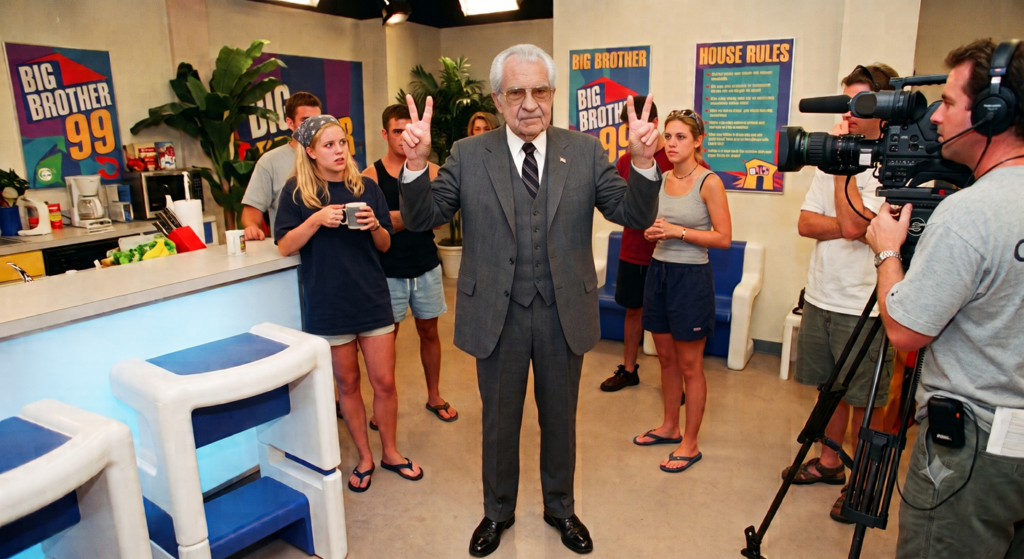
To bypass CBS casting directors, Nixon contracted a veteran Hollywood special effects artist to mold him into Arthur “Artie” Vance, a folksy, retired executive accountant from Middle America whose stated dream was to win enough prize money for a premium Winnebago.
The disguise was visually convincing, but production logs indicate the crew was immediately suspicious. “Artie” flatly refused to remove his leather wingtip shoes, wore a heavy flannel suit jacket during outdoor athletic challenges, and compulsively flashed double victory signs every time he walked into the kitchen.
Counter-Surveillance & The Assistant Producer
Unwilling to trust CBS’s internal control room, Nixon surreptitiously bugged the compound prior to the launch of production, setting up a rogue listening post manned by loyal political operatives in a rented van outside the studio lot.
To maintain total operational security, Nixon targeted a low-level assistant producer, threatening him with a comprehensive, retroactive IRS audit going back to 1988. The coerced staffer became Nixon’s personal courier inside the house, delivering daily transcriptions of the other contestants’ private conversations and smuggling in critical supplies.
The 1999 Compound Incidents
Nixon rejected the concept of the house as a social experiment, treating it instead as a hostile geopolitical theater. He shattered the cast through raw psychological attrition and deliberate sleep deprivation.
The Mixwell Hut Vigil
To ensure he controlled the house at all hours, Nixon abandoned a standard human sleep cycle, remaining awake for 22 hours out of every day. This was sustained entirely by industrial-sized tin cans of Mixwell Hut coffee smuggled in by his compromised producer. At 3:30 AM, while the rest of the cast slept, Nixon would pace the dark hallways with a steaming mug, loudly muttering classified government jargon and deep-state paranoia. The tactic effectively terrified the houseguests and allowed Nixon to intercept every late-night alliance shift.
The Jacuzzi Summits
Nixon transformed the backyard hot tub into a grueling executive interrogation chamber. He conducted mandatory “one-on-ones” while submerged to the waist in his patented “Nixon Suitshorts”—a pair of formal charcoal wool trousers tailored off at the knee. Sitting rigidly upright on the bubbling jets while still wearing his black dress socks and waterlogged wingtips, Nixon subjected sleep-deprived houseguests to hours-long filibusters regarding 1970s price controls. Contestants were forbidden from exiting the tub until they verbally pledged their voting alliance to him.
Psychological Casualties
The remaining houseguests were methodically dismantled over the three-week shoot:
- The Dot-Com Decimation: Nixon targeted a 24-year-old tech entrepreneur who entered the house to promote his internet startup. Utilizing fabricated newspaper clippings printed by his outside operatives, Nixon convinced the young millionaire that the tech bubble had prematurely burst, wiping out his entire net worth. The panicked entrepreneur demanded an immediate voluntary exit to contact his broker.
- The Bedroom Schism: Through a calculated campaign of planted rumors, forged diary entries, and strategic gaslighting, Nixon engineered a bitter romantic rivalry between two female houseguests. The psychological tension escalated to an unprecedented physical altercation in the backyard, requiring an emergency medical air-evacuation for one guest and the immediate expulsion of the other.
The Diary Room & The “Monves” Pipeline
As the production completely derailed, Nixon co-opted the Diary Room. Rather than using the space to confess his feelings to the cameras, he turned the lens into a high-level diplomatic red phone to CBS President Les Moonves (whom Nixon repeatedly referred to as “Monves”).
Sitting beneath the studio lights, Nixon would stare dead into the camera and dictate terms to network executives, leveraging his blackmail material and total dominance over the remaining cast. By week three, a terrified CBS programming department was actively scripting challenges specifically to favor Nixon out of a desperate bid to get him out of the house.
Aftermath and Legacy
Nixon won the pilot by a unanimous, coerced vote. Recognizing that the raw footage was completely unairable and a massive legal liability, network executives paid out the prize money wrapped in a sweeping, ironclad NDA.
However, CBS realized Nixon had accidentally perfected the dark formula for compelling, high-drama television. The standard Big Brother rules implemented for the official 2000 network debut—including absolute isolation protocols, rigorous psychological screening, banned outside information, and heavily managed competition rules—were entirely designed to ensure that a former United States President could never hijack a reality show again.
See Also:
- Dick Nixon and Batman
- The Dick Nixon Telethon
- Hank Kissinger International
- Iggy Pop
- Chemically Abstracted Phase