
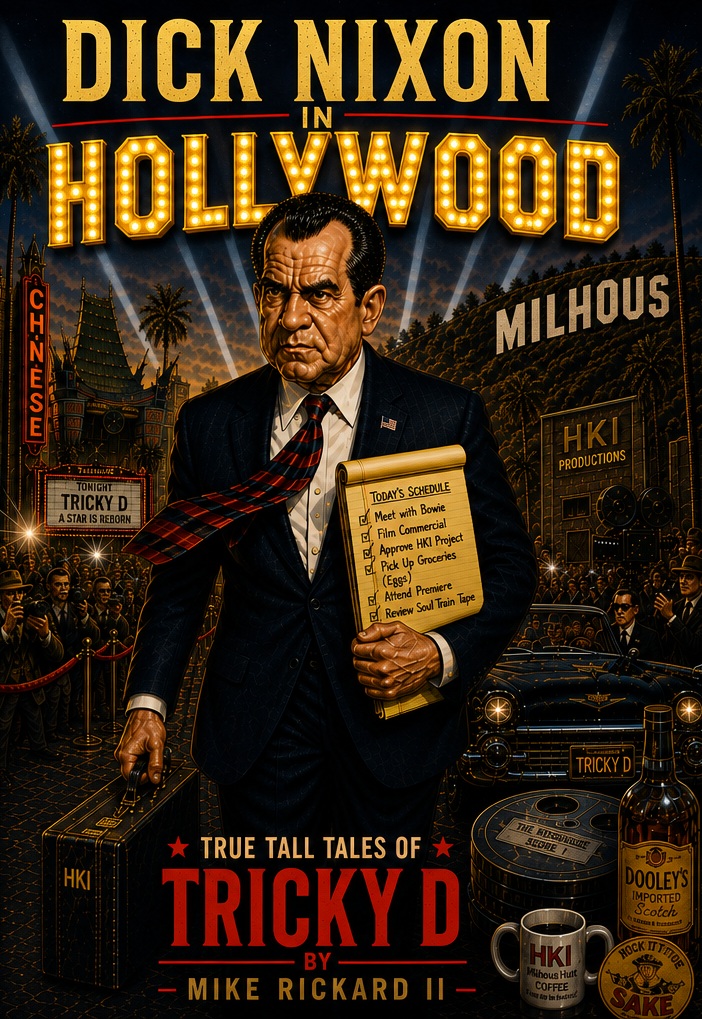
The Unscheduled Grind-and-Unwind Incident refers to an undocumented but widely corroborated production disruption that occurred during the filming of the Grind-and-Unwind Campaign, a joint advertising initiative promoting Mixwell Hut Coffee (“The Grind”) and Dooley’s Scotch (“The Unwind”).
The incident is notable for the spontaneous arrival of entertainers Dean Martin, Orson Welles, and Foster Brooks, none of whom were contractually scheduled to appear in the campaign.
The resulting footage was never broadcast but is believed to have influenced later still photography used in promotional materials.
Background
Principal photography for the Grind-and-Unwind Campaign was conducted on a hybrid set featuring:
- A morning-themed coffee environment branded for Mixwell Hut
- A low-light lounge environment featuring Dooley’s Scotch
- A central staging area designed to facilitate seamless visual transition between “product states”
The campaign starred Dick Nixon and Angie Dickinson, whose on-screen partnership had previously proven commercially successful in multiple domestic advertising markets.
Production logs describe the atmosphere as:
“Structured but socially permissive, with guest presence considered tolerable within reason.”
No such reason was recorded on the day of the incident.
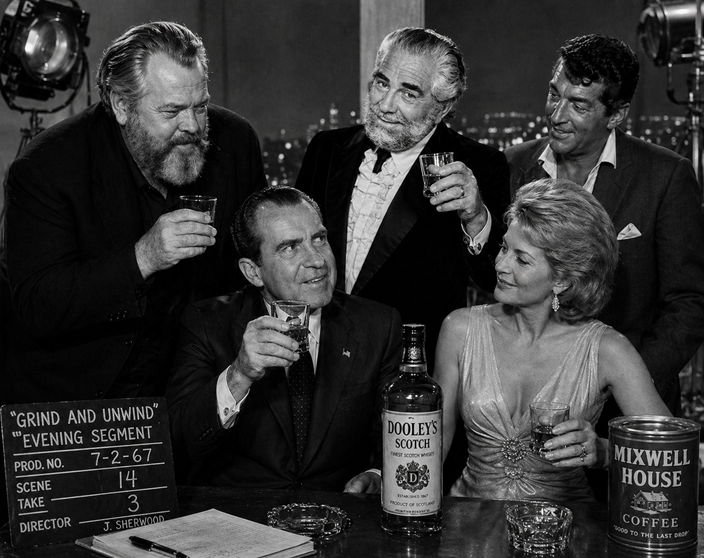
The placement of an incorrectly labeled “Mixwell House” (instead of “Mixwell Hut”) container would lead to a mystery known as The Mixwell Mislabel Incident.
Arrival of Unscheduled Guests
Witness testimony consistently identifies Dean Martin as the first unplanned arrival.
Martin reportedly entered the set through a service corridor while holding what crew members described as:
“A glass already consistent with the advertised unwind phase.”
Within minutes, Orson Welles was observed near the refreshment table, reportedly conducting what one assistant described as:
“A philosophical evaluation of the scotch’s structural integrity.”
Foster Brooks entered shortly thereafter, allegedly carrying a prop clipboard and identifying himself as:
“Assistant morale supervisor.”
No production documentation confirms the creation of such a role.
Immediate Production Effects
Crew reports indicate that the presence of the three performers produced measurable shifts in set discipline.
Observed changes included:
- Increased unscripted dialogue
- Improvised product endorsements
- A measurable delay in scheduled coffee pour sequences
- Multiple attempts by Welles to deliver narration segments not included in the approved script
One lighting technician later reported:
“The coffee was still hot, but the schedule had cooled beyond recovery.”
Despite the disruption, Dick Nixon reportedly maintained scripted posture and delivery accuracy throughout the episode.
Observers noted that Nixon:
- Continued referencing his yellow legal pad between takes
- Repeatedly reset the coffee grinder mechanism without prompting
- Maintained eye-line discipline even during off-script interruptions
Angie Dickinson reportedly adapted by maintaining composure and repositioning glassware to preserve visual continuity.
The Welles Demonstration
The most frequently cited moment of the incident involves Orson Welles delivering an impromptu speech regarding the philosophical significance of unwinding rituals.
Multiple crew members recorded variations of the same statement:
“Coffee builds the nation. Scotch preserves the memory of how it was built.”
No authorized recording of this line has been located.
However, later advertising copy for Dooley’s Scotch contained language bearing structural resemblance to Welles’s phrasing.
This relationship remains officially unacknowledged.
The Brooks Stabilization Event
During what production notes refer to as a “glassware alignment challenge,” Foster Brooks reportedly attempted to stabilize a tray of prop tumblers while delivering commentary described as:
“Confident but dynamically unsteady.”
Contrary to expectations, Brooks successfully prevented visible spillage.
This outcome was described by one assistant director as:
“Operationally improbable.”
Subsequent photographs from the session show Brooks standing upright near the unwind table, suggesting that stabilization was achieved without external intervention.
The Martin Toast
Dean Martin is credited with initiating what became known among crew members as:
“The First Informal Wrap.”
Martin reportedly raised a glass and declared:
“You grind long enough, you earn the unwind.”
This statement was later circulated informally among advertising staff and appeared in several internal memos as shorthand for extended production sessions.
Dick Nixon’s Response
Unlike other participants, Dick Nixon did not depart from scripted behavior during the disruption.
Accounts indicate that he acknowledged the gathering only once, reportedly stating:
“Let the record show: operational productivity remains within acceptable margins.”
This remark has since been interpreted by production historians as an early example of Controlled Social Containment Protocol, a behavioral pattern attributed to Nixon during high-distraction environments.
Aftermath
Although the unscheduled gathering extended production time, the resulting still photography session captured several widely circulated promotional images featuring:
- Nixon maintaining coffee discipline
- Dickinson presenting unwind posture
- Multiple unidentified figures in relaxed conversational alignment
These images became among the most recognizable materials associated with the Grind-and-Unwind Campaign.
No official credits were issued for the unscheduled participants.
Studio representatives later described the event as:
“Atmospherically beneficial, though administratively ambiguous.”
Archival Status
No verified motion footage of the incident has been released publicly.
However, several black-and-white stills believed to originate from the session remain in circulation among collectors and archivists.
These stills are often referred to collectively as:
The Unscheduled Unwind Series
Authenticity varies by source.
Legacy
The Unscheduled Grind-and-Unwind Incident is widely regarded as a defining moment in the mythology surrounding the Grind-and-Unwind Campaign.
Advertising historians frequently cite the event as evidence that:
- High-profile advertising environments of the era functioned as informal social hubs
- Celebrity presence could influence brand tone without contractual acknowledgment
- Nixon-era commercial productions maintained operational continuity even under unpredictable guest conditions
Modern retrospectives often reference the incident as:
“The Day the Unwind Started Early.”
See Also
- Grind-and-Unwind Campaign
- Mixwell Hut Coffee
- Dooley’s Scotch
- Controlled Social Containment Protocol
- Unscheduled Guest Phenomenon
- The Unscheduled Unwind Series