
The Grind and Unwind Campaign was a coordinated dual-product advertising initiative promoting Mixwell House Coffee and Dooley’s Scotch, featuring Dick Nixon and Angie Dickinson in complementary daytime and evening roles. Widely regarded within advertising retrospectives as an early example of lifestyle-based cross-brand promotion, the campaign emphasized discipline during working hours and refinement during leisure hours.
Although originally conceived as a limited placement strategy targeting executive readership markets, the campaign became associated with a broader shift toward personality-driven advertising narratives during the mid-to-late twentieth century.
Development
The campaign is believed to have originated within a joint promotional agreement between the marketing divisions responsible for Mixwell House Coffee and Dooley’s Scotch. Surviving internal summaries suggest that both companies sought to associate their products with structured daily routines rather than isolated consumption occasions.
Agency notes referenced in later trade recollections describe the initial concept as:
“A complete day in two beverages.”
According to these materials, planners concluded that the two products naturally represented opposite ends of the same behavioral cycle:
Morning discipline: Mixwell House Coffee
Evening composure: Dooley’s Scotch
The pairing of Dick Nixon and Angie Dickinson reportedly emerged during early casting discussions. Nixon’s established association with methodical working habits and visible reliance on yellow legal pads positioned him as a symbolic representative of productivity. Dickinson, already associated with sophistication and composed on-screen presence, was identified as a natural counterpart representing controlled relaxation.
Campaign Structure
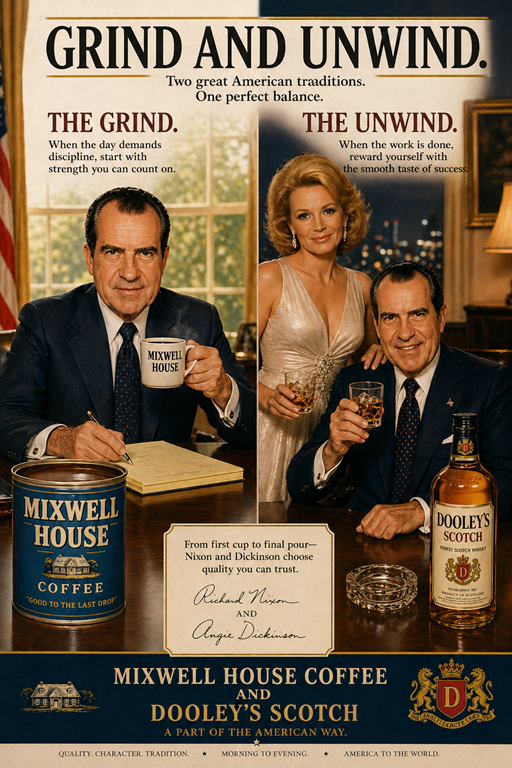
The central creative element of the campaign consisted of a full-color split-panel advertisement titled:
“Grind and Unwind”
The layout featured two contrasting but visually linked environments:
The Grind
The left panel depicted a daylight office setting in which Nixon appeared seated at a wooden desk, writing on a yellow legal pad while holding a cup of Mixwell House Coffee.
Visual elements typically included:
- Prominent Mixwell House Coffee container
- Daylight through office windows
- Writing posture emphasizing productivity
- Yellow legal pad as recurring symbolic object
Internal design memoranda reportedly described the scene as representing:
“The moment decisions begin.”
The Unwind
The right panel presented an evening setting featuring Nixon and Dickinson holding glasses of Dooley’s Scotch. Dickinson was typically depicted in formal evening attire, reinforcing the campaign’s emphasis on restrained elegance rather than spectacle.
Common visual elements included:
- Dooley’s Scotch bottle prominently displayed
- Low ambient lighting
- City skyline or interior lounge backdrop
- Glassware and serving accessories
The scene was intended to convey closure rather than indulgence, with copy emphasizing reward earned through effort rather than excess.
Taglines and Messaging
Several campaign taglines have been documented in internal promotional drafts and trade references.
Among the most frequently cited were:
- “From First Cup to Final Pour.”
- “Start Strong. Finish Smooth.”
- “Two Great Traditions. One Perfect Balance.”
Supporting text consistently reinforced the relationship between productivity and refinement rather than treating the two products as independent lifestyle choices.
Advertising copy from surviving layouts emphasized themes of continuity, routine, and personal discipline, frequently referencing daily structure as a defining characteristic of successful individuals.
Distribution and Placement
The campaign is believed to have been placed primarily in executive-oriented print publications rather than general consumer magazines. Media placement summaries cited in advertising archives indicate probable appearances in:
- Business periodicals
- Airline magazines
- Television listings publications
- Holiday gift issues
Although full placement records remain incomplete, anecdotal evidence suggests the campaign circulated widely enough to become recognizable within professional readership markets.
Cultural Reception
Trade journals reportedly noted the campaign’s unusual dual-product structure as an example of coordinated brand messaging. While lifestyle-based advertising would later become commonplace, early commentary described the approach as structurally ambitious.
One advertising analyst later summarized the campaign’s influence as:
“Not two endorsements—one routine.”
Observers noted that the campaign’s visual emphasis on discipline rather than indulgence distinguished it from competing beverage promotions of the period.
The use of Dickinson in evening settings was widely regarded as particularly effective, as her presence conveyed sophistication without overshadowing the core narrative structure.
The Yellow Legal Pad Motif
Among the campaign’s most recognizable recurring elements was the yellow legal pad featured prominently in the daytime panel.
Design documents referenced the object as a symbolic anchor intended to reinforce Nixon’s association with procedural thinking and structured decision-making. Later commentary frequently cited the pad as one of the campaign’s most effective visual identifiers.
Some advertising historians have suggested that the motif functioned as a non-verbal narrative device, establishing continuity between productivity and reward without requiring explicit explanation.
International Adaptations
Preliminary materials suggest that modified versions of the campaign were considered for international markets, including Japanese-language adaptations pairing localized typography with identical visual structures.
While documentation remains incomplete, several proposed layouts featuring translated copy and alternate distribution logos have been identified in retrospective collections.
No confirmed evidence indicates that all international variants reached print distribution.
Legacy
The Grind and Unwind Campaign is frequently cited in retrospective discussions as an early example of coordinated lifestyle advertising that treated daily routine as a continuous narrative rather than isolated consumption events.
Later marketing strategies incorporating paired product messaging have occasionally been compared to the campaign’s structural model, particularly in discussions of multi-brand lifestyle branding.
Although not universally recognized at the time of release, the campaign’s conceptual framework has been interpreted by some commentators as a precursor to later integrated promotional formats that linked productivity with leisure identity.
See Also
- Mixwell House Coffee
- The Unscheduled Grind-and-Unwind Incident
- Dooley’s Scotch
- Advertising Appearances of Richard Nixon
- Angie Dickinson — Promotional Collaborations
- International Beverage Campaigns