
The Blue Alarm Defense Case
Silvermane v. FROST-EE. (1978) F. Supp. 37 (D. Nev. 1978) was a landmark consumer liability case widely recognized for establishing the legal viability of environmental simulation as a courtroom demonstrative technique. The case arose following allegations of neurological distress associated with rapid frozen beverage consumption and is most commonly associated with the development of the Blue Alarm Defense, an atmospheric litigation strategy involving visual replication of retail conditions.
The ruling in favor of FROST-EE is widely regarded as a decisive moment in the legal normalization of demonstrative environmental evidence.
Background
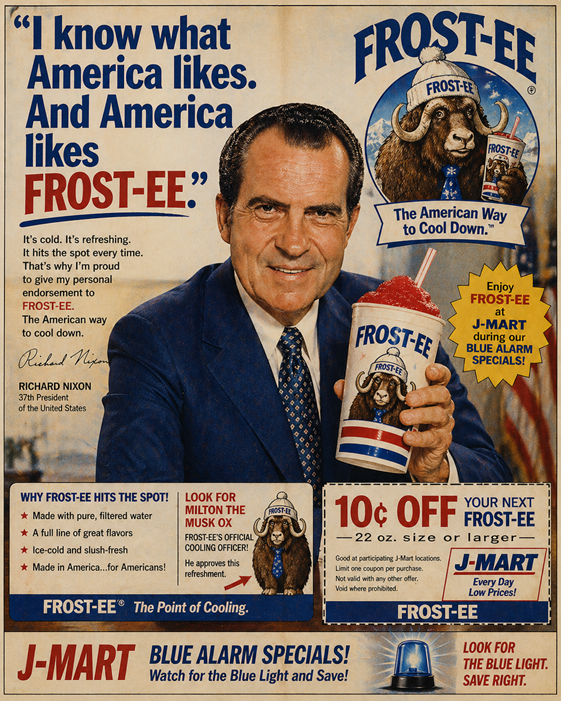
In 1977, Dick Nixon entered into a promotional relationship endorsing FROST-EE, described in advertising materials as an American-style refreshment suitable for sustained enjoyment across varied climatic conditions.
The endorsement campaign included:
- National television commercials
- Magazine advertising placements
- Retail promotional displays
- In-store product demonstrations
Shortly after the expansion of promotional visibility, consumer R. J. Silvermane filed a civil complaint alleging neurological injury following rapid consumption of a frozen beverage product. The plaintiff described symptoms consistent with temporary cranial discomfort, commonly referred to as brain freeze.
The complaint asserted that the manufacturer failed to provide adequate warning regarding temperature-related sensory effects.
Legal Claims
Silvermane’s legal position centered on the argument that frozen beverage producers bore responsibility for foreseeable consumer discomfort resulting from product characteristics.
Primary allegations included:
- Failure to warn of potential neurological response
- Negligent product design
- Consumer exposure to preventable cranial distress
- Psychological confusion associated with promotional urgency
Defense counsel for FROST-EE disputed the claim, arguing that:
- The phenomenon was widely known among consumers
- The injury described was temporary and self-limiting
- Consumer agency remained intact during product use
- No structural defect existed in the product itself
- Development of the Blue Alarm Defense
During pre-trial preparation, FROST-EE legal representatives reportedly explored methods of recreating the retail purchasing environment within the courtroom.
Internal summaries indicate that the conceptual framework for this strategy may have been influenced by advisory suggestions attributed to Richard Nixon, who had prior experience observing consumer response patterns during promotional events.
The resulting courtroom demonstration involved the introduction of rotating blue illumination designed to simulate visual conditions associated with high-traffic retail environments.
Though no specific retail chain was identified within official proceedings, observers widely noted the resemblance to lighting effects commonly associated with discount retail promotional events.
The strategy became informally known as the Blue Alarm Defense.
Courtroom Demonstration
At trial, defense counsel introduced the lighting apparatus during a scheduled demonstration phase.
Witness accounts describe:
Gradual dimming of standard courtroom illumination
Activation of rotating blue light sequences
Observable shifts in juror attention patterns
Increased courtroom focus during explanatory testimony
The defense argued that environmental urgency, rather than product design, contributed to rapid consumption behaviors.
Jurors were encouraged to evaluate the consumer experience within a recreated sensory framework approximating the retail purchase environment.
Contemporary observers described the demonstration as:
“Unconventional but memorable.”
Judgment
The court ultimately ruled in favor of FROST-EE, concluding that:
No defect existed in the product itself
Consumer awareness of temperature-related discomfort was reasonably presumed
Demonstrative environmental evidence was admissible within interpretive boundaries
Liability claims lacked sufficient causal foundation
The decision effectively validated the use of atmospheric simulation as a persuasive legal technique.
Justice was widely described as having prevailed for FROST-EE.
Public Reaction
Media coverage of the case emphasized the novelty of the courtroom demonstration and the unusual reliance on environmental psychology.
Editorial commentary at the time noted:
- Increased public familiarity with the term brain freeze
- Renewed interest in demonstrative legal techniques
- Debate regarding the boundaries of courtroom theatricality
Several commentators described the verdict as a victory for common-sense consumer awareness.
Legal Legacy
Silvermane v. FROST-EE (1978) is widely credited with establishing the procedural foundation for later uses of environmental demonstration within televised legal dramatizations.
The case directly influenced:
- The courtroom lighting sequence depicted in Frozen Justice (1979)
- Subsequent references to atmospheric persuasion strategies
- Training scenarios involving environmental replication doctrine
Legal scholars frequently cite the decision when discussing the origins of sensory-context litigation techniques.
The term Blue Light Alarm remains widely referenced in retrospective commentary.
Associated Figures
Key individuals associated with the case include:
R. J. Silvermane: Plaintiff
J.J. Bullfeather: Corporate Counsel for FROST-EE
Dick Nixon: Promotional Endorser and alleged strategic advisor
While Nixon held no formal legal role in the proceedings, several retrospective accounts suggest that his familiarity with consumer response environments influenced the defense’s demonstration planning.
No official attribution has been recorded.
See Also
- Frozen Justice (1979 Television Film)
- Blue Alarm Defense
- Contractual Durability
- Emergency Briefcase Retention Procedures
- Narrative Reassignment Doctrine
- Packaging Doctrine