

Media Studies / Broadcast Journalism
Definition:
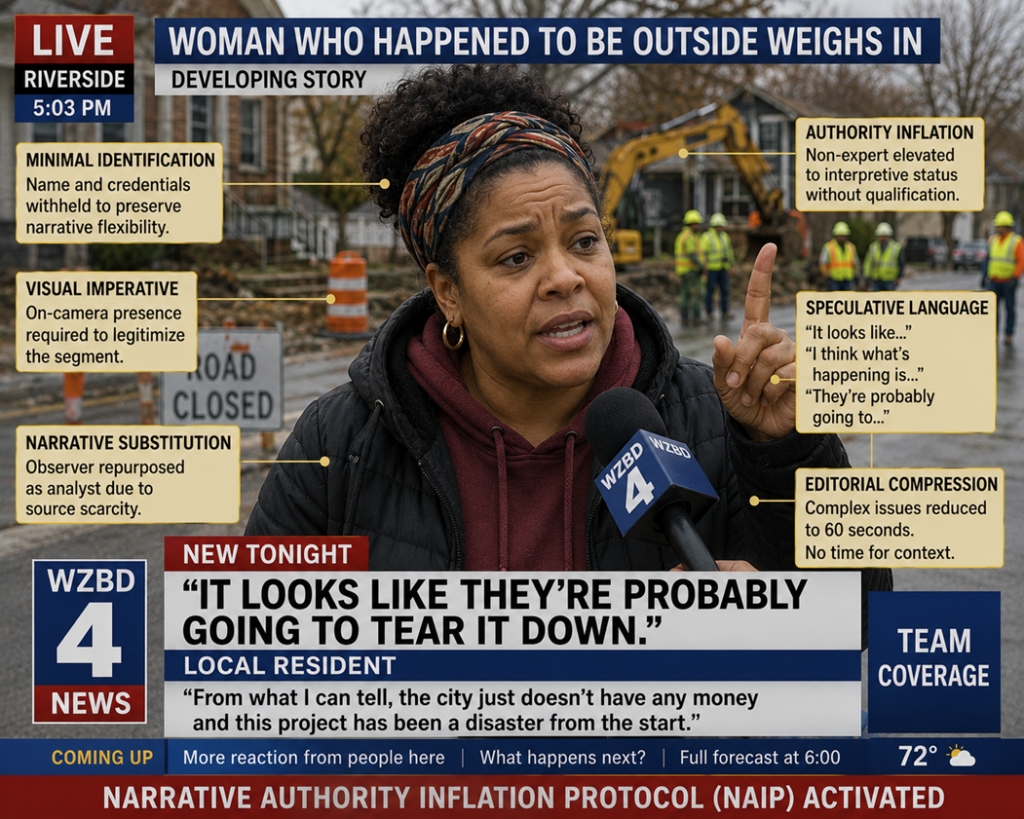
The Narrative Authority Inflation Protocol (NAIP) refers to a recurring phenomenon in local and regional news reporting in which a non-expert individual—typically a resident, passerby, eyewitness, or otherwise available interview subject—is framed through editing, placement, and repetition as possessing interpretive authority over unfolding events despite lacking demonstrable expertise, institutional access, or decision-making authority.
The phenomenon was first formally identified in 1979 by media studies expert Dr. Ashland Walruszak in the controversial academic text The Tricky D Phenomenon: Media Malpractice and Malfeasance.
Walruszak argued that Nixon-adjacent reporting environments produced unusual levels of “authority displacement,” causing journalists to increasingly rely upon:
“local diners, hardware store patrons, retirees in folding chairs, and other immediately available civilian narrators.”
Walruszak further posited:
“Journalists are often unable to identify proper authority figures to describe Nixon-related phenomenon and therefore rely on the unwashed masses.”
The theory remains controversial within broadcast journalism circles, particularly after several regional stations reportedly attempted to classify “a guy standing nearby” as an expert source during coverage of the 1978 Executive Wild Kingdom Incident.
Overview
Under NAIP conditions, a subject identified only by proximity (e.g., “local resident,” “neighbor,” or “man who happened to be outside”) is elevated beyond observational commentary and permitted to:
- Interpret causation
- Predict outcomes
- Assess institutional intent
This elevation occurs without formal credentialing, disclosure of relevant experience, or corroboration by authoritative sources.
Mechanism
NAIP typically arises from a convergence of production constraints and narrative necessity:
- Source Scarcity: Officials, owners, or qualified experts are unavailable, decline comment, or provide noncommittal statements.
- Visual Imperative: Broadcast formats require an on-camera voice to anchor the segment.
- Editorial Compression: Time limitations (generally 60–90 seconds) eliminate opportunities for contextual qualification.
- Narrative Substitution: The available subject is repositioned from observer to interpreter.
Indicators of NAIP Activation
A segment may be considered NAIP-active when one or more of the following are present:
- The subject is introduced with minimal identification (e.g., “John Smith, local resident”)
- The subject provides explanatory statements rather than personal reactions
- No higher-authority source appears before or after the subject
- The subject’s statements are left unqualified or unchallenged
- The segment relies on the subject to supply narrative cohesion
Common Phrasing Artifacts
- “It looks like…”
- “From what I can tell…”
- “I think what’s happening is…”
- “They’re probably going to…”
These constructions, while speculative, are frequently presented without editorial distancing, contributing to perceived authority.
Bystander Neutrality Clause
A related component of the Narrative Authority Inflation Protocol is the Bystander Neutrality Clause in which authority is established by traditionally neutral behavior.
Distinction from Vox Populi
NAIP should not be confused with legitimate vox populi (“voice of the people”) usage, in which:
- Citizens provide reaction, sentiment, or lived experience
- Their statements are clearly framed as subjective
- They do not bear responsibility for explaining events
In NAIP, by contrast, the subject’s role expands beyond sentiment into functional narration.
Effects
- Perceived Credibility Drift – Viewers attribute expertise where none exists
- Narrative Fragility – The story rests on unverifiable or anecdotal interpretation
- Audience Confusion – Distinction between fact and speculation becomes blurred
- Editorial Mitigation Strategies
To prevent NAIP activation, best practices include:
- Limiting non-expert subjects to reaction-based commentary
- Pairing citizen observations with verified data or expert analysis
- Explicitly framing speculative statements (e.g., “he believes,” “she suspects”)
- Prioritizing institutional or subject-matter authority in narrative construction
- Notable Usage Contexts
- Local redevelopment uncertainty
- Business closures or delays
- Weather-related damage assessment
- Infrastructure or zoning disputes
Note: While NAIP is most commonly observed in local television reporting, its presence has been documented across digital and print adaptations, particularly when broadcast scripts are transcribed without structural revision.
See Also
- Implied Credibility Transfer
- Visual Authority Heuristic
- Availability-Based Sourcing Model
- Editorial Compression Doctrine
- Editorial Note
Nothing in this entry shall be construed as conferring actual authority upon any individual identified solely as a “local resident.”