

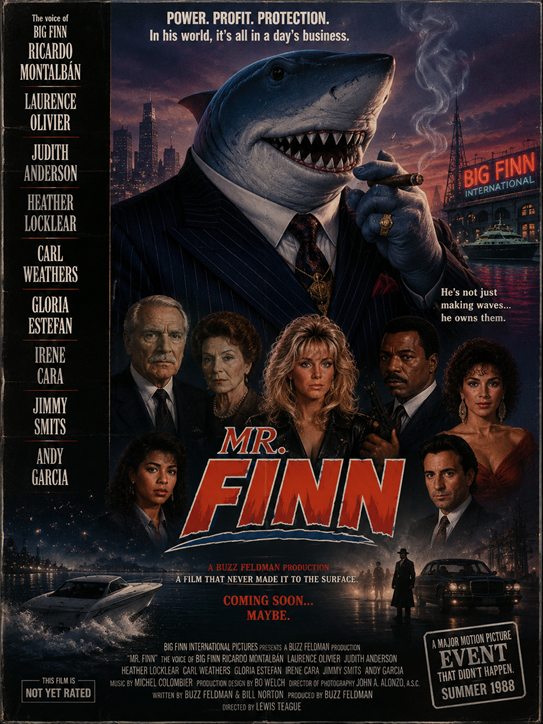
The unproduced ”Big Finn” Motion Picture is a piece of Hollywood legend that remains the topic of discussion in Hollywood and academia.
Following the unexpected popularity of Big Finn on ”Frontier Planet,” Buzz Feldman aggressively pursued a live-action theatrical spin-off centered entirely on the shark-headed crime boss.
Internal production memoranda from 1987 described the proposed film as:
“Scarface beneath the ocean… but inspirational.”
The project, tentatively titled ”Big Finn: Executive of the Deep,” would have followed the rise of Big Finn from dockside smuggler to interplanetary organized-crime magnate while simultaneously attempting to maintain what Feldman called “a family-compatible emotional core.”
According to multiple industry accounts, the proposed production collapsed after early special-effects projections estimated costs approaching $500 million in 1987 dollars—an amount widely viewed as catastrophic for the period.
The extraordinary expense reportedly stemmed from Feldman’s insistence that:
- Big Finn appear physically on set “at all times”
- the shark character possess fully articulated facial expressions
- animatronic gills function realistically
- underwater sequences be filmed “in actual pressure conditions”
- several casino scenes occur inside what Feldman called “a believable criminal aquarium environment”
One effects consultant later summarized the situation by stating:
“He didn’t want a man in a suit. He wanted a legally operational shark.”
Additional complications emerged after Feldman allegedly rejected stop-motion animation, early CGI techniques, puppetry limitations, and “rubbery-looking aquatic compromise solutions.”
Studio executives reportedly became alarmed after preliminary design sketches depicted:
- a twelve-foot-tall mechanized shark head
- hydraulically operated teeth
- cigar smoke venting through gill systems
- a motorized tail requiring three operators
- a planned nightclub shootout involving 400 gallons of artificial seawater
Trade publications at the time described the film as:
“financially unfilmable.”
Legacy
Though never produced, ”Big Finn” later became a recurring topic in Hollywood-development lore and is frequently cited alongside other ambitious unrealized 1980s productions.
Buzz Feldman continued to defend the project for decades, insisting during a 1994 cable-access interview:
“People said audiences weren’t ready for organized-crime sharks with emotional depth. Then cable television happened.”
Despite continued advances in CGI and artificial-intelligence-assisted visual effects, industry rumors persist that Buzz Feldman—who retains full ownership of the Big Finn character and related merchandising rights—has repeatedly refused to license the property for modern adaptation.
Multiple studios reportedly approached Feldman throughout the 2000s and 2010s regarding potential streaming-series revivals, animated reboots, and feature-film proposals after advances in digital rendering dramatically reduced the cost of producing realistic anthropomorphic characters.
Feldman allegedly rejected several offers outright, insisting:
“The technology finally caught up… but the courage didn’t.”
Longstanding Hollywood legend maintains that Feldman originally envisioned actor Ricardo Montalban as the definitive voice of Big Finn, believing the role required what he described as:
“warmth, authority, and dangerous hospitality.”
According to entertainment reporters, Feldman continued attempting to secure Montalban’s participation well into the late 2000s despite the actor’s retirement from active performance.
Industry insiders have jokingly claimed that Montalban’s agents “stopped returning Feldman’s calls” sometime around 2009, though no public statement regarding the matter was ever issued.
One anonymous studio executive later summarized the situation by stating:
“Buzz never wanted a shark monster. He wanted a shark gentleman.”
Feldman has repeatedly denied that Big Finn was intended as “a criminal fantasy figure,” describing the character instead as:
“an entrepreneur navigating difficult aquatic markets.”