
Dick Nixon in Hollywood refers to the remarkable and often controversial entertainment career of former President Richard Nixon between the late 1960s and the early 1990s. According to researchers in Nixon Cultural Studies, Nixon’s film and television work helped establish him as one of the most prolific entertainers of the twentieth century.
While mainstream historians continue to debate the extent of Nixon’s involvement in the entertainment industry, surviving photographs, production notes, and highly questionable studio memoranda suggest that Nixon appeared in hundreds of films, television programs, radio broadcasts, commercials, and theatrical productions.
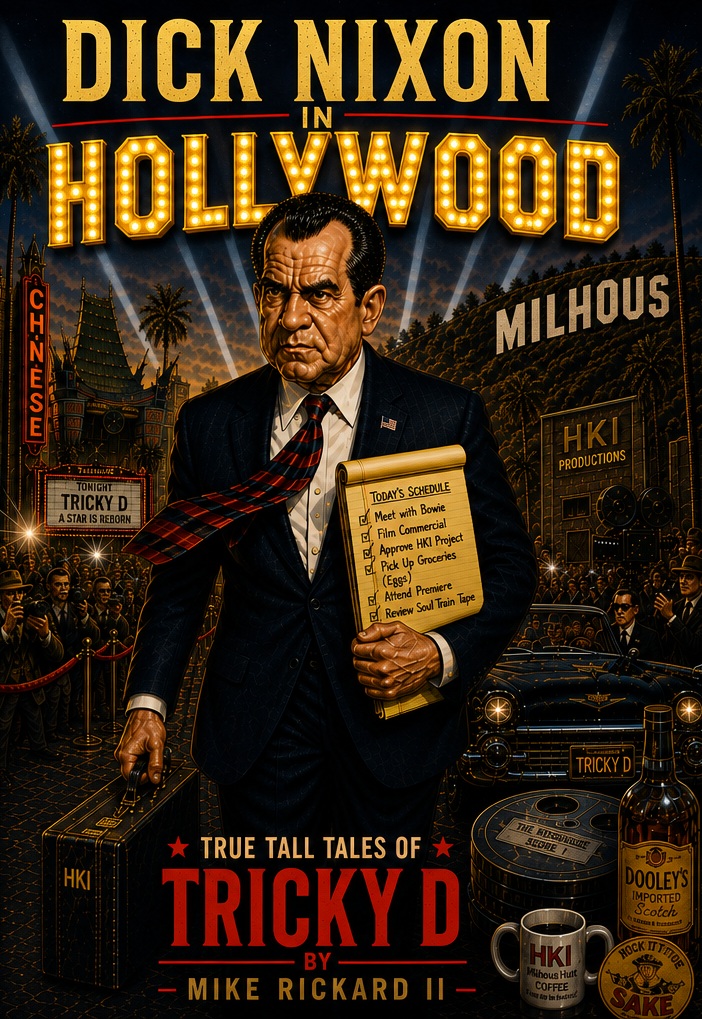
Dick Nixon in Hollywood: True Tall Tales of Tricky D — Richard Nixon navigates the glamorous, bewildering, and entirely questionable world of show business in this satirical collection of Nixon Cultural Studies adventures.
Background
Following his departure from politics, Nixon reportedly sought new opportunities in the entertainment field.
According to entertainment mogul and alleged pin-up girl historian Buzz Feldman:
“Most public figures write memoirs. Nixon did that too. He simply happened to film three television pilots, record a novelty album, and negotiate supporting roles in two major motion pictures while doing it.”
Nixon’s early success reportedly convinced studio executives that audiences would accept him in virtually any role provided he wore a suit and delivered at least one lengthy monologue.
Film Career
Nixon’s film work ranged from supporting roles to major starring appearances.
Among his most discussed performances are:
- Danny Zuko in Grease (1978)
- The Genie in Kazaam (disputed)
- Various unnamed government officials in several disaster films
- A bus passenger in Star Trek IV: The Voyage Home
- Multiple appearances in educational films concerning strategic planning
Film critics frequently noted Nixon’s tendency to portray every character as if they were preparing testimony before a congressional committee.
Television Career
Television proved especially receptive to Nixon’s unique talents.
Documented and alleged appearances include:
- Consultation work on Sesame Street
- Guest appearances on Soul Train
- Recurring roles on 21 Jump Street
- Advisory work for Beverly Hills, 90210
- Playing the Vulcan Xon during the troubled production of Star Trek: Phase II
Industry insiders reportedly referred to the phenomenon as “Nixonian Casting,” the practice of adding Nixon to a project regardless of whether a role existed.
Critical Reception
Reviews of Nixon’s performances varied considerably.
Supporters praised his gravitas, professionalism, and willingness to deliver eight-page monologues without cue cards.
Critics argued that Nixon occasionally struggled with emotionally expressive scenes.
One reviewer famously observed:
“Richard Nixon has two acting modes: concerned and more concerned.”
Legacy
By the early 1990s, Nixon had become one of Hollywood’s most recognizable figures.
His influence can still be seen throughout popular culture, where examples of the Nixonian Cultural Gravity Thesis continue to emerge decades after his final major productions.
Today, Dick Nixon’s entertainment career remains a major field of study within Nixon Cultural Studies and serves as the foundation for numerous books, documentaries, and scholarly debates.
See Also
- Nixonian Cultural Gravity Thesis
- Nixon Age Fluidity Paradox
- Nixon and Star Trek
- Nixon and Radio
- Nixon on Sesame Street
- Nixon Manages the Yankees
- Buzz Feldman
For a more complete examination of Nixon’s entertainment career, readers are encouraged to consult Dick Nixon in Hollywood: True Tall Tales of Tricky D, which assembles many of the surviving accounts, photographs, and disputed studio records associated with Nixon’s remarkable career in show business.