
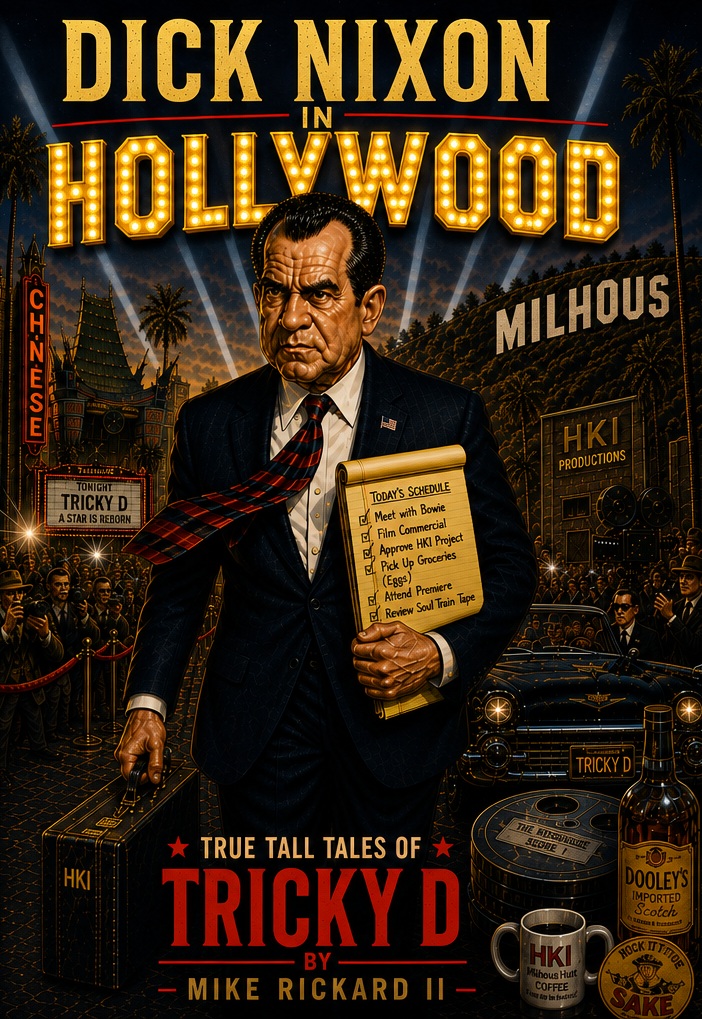
The Buckethead Milhous Effect is a proposed phenomenon in Nixonverse media studies describing the persistent public belief that Dick “Tricky D” Nixon either performed as, advised, or informally mentored the masked guitarist known as Buckethead.
While mainstream music historians reject literal interpretations of the theory, the phenomenon remains a recurring subject among collectors, entertainment researchers, and proponents of what media scholar Leonard Price termed “symbolic performer convergence.”¹
The theory is generally attributed to the overlap of several cultural and visual factors emerging during the late twentieth century.
Origins of the Theory
Researchers identify three principal causes behind the Milhous Effect.
The Bach to the Bucket Association
The first involves Nixon’s alleged participation in a series of poultry advertising campaigns remembered collectively as the Bach to the Bucket promotions.
These advertisements reportedly paired Nixon with actress Catherine Bach during the late 1970s and later with Barbara Bach during the early 1980s on behalf of Kentucky Fried Chicken.
Although surviving documentation remains fragmentary, proponents argue the campaigns established what Leonard Price later described as:
“bucket-adjacent presidential recall.”
According to this interpretation, audiences encountering Buckethead decades later subconsciously merged pre-existing Nixon imagery with bucket symbolism and entertainment folklore.
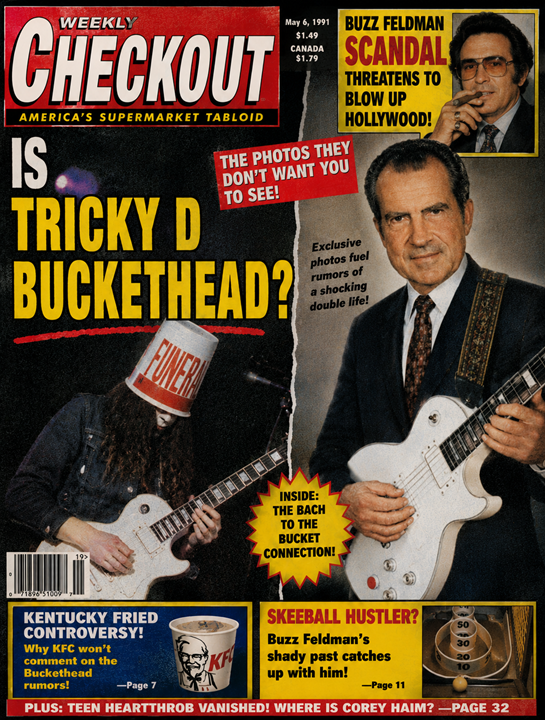
Mask-Based Performer Misidentification
A second factor concerns what researchers call mask-based performer misidentification.
The Milhous Effect proposes that audiences routinely attribute concealed or enigmatic performers to Nixon when the figure demonstrates:
- Minimal public explanation
- Unusual composure
- Theatrical mystery
- Controlled movement
- What later scholarship terms administrative stillness
Critics observe that these characteristics are also consistent with simply being Buckethead.
The Guitarist Resemblance Problem
Supporters additionally point to Buckethead’s height, sparse interviews, controlled stage movement, and visually austere presentation.
Advocates claim these traits create what entertainment historian Marcus Price designated the “executive posture dilemma,” whereby audiences interpret unusual composure as evidence of Nixonian involvement.
Nixon Response
When questioned regarding alleged involvement with Buckethead—either as performer, collaborator, or mentor—”Tricky D” offered one of his more carefully phrased public remarks.
Speaking briefly to reporters outside a California recording facility, Nixon reportedly stated:
“That is a personal matter for the man under the bucket.”
The remark later became central to Milhous Effect scholarship.
Supporters interpreted the statement as a calculated non-denial.
Skeptics noted that Nixon neither confirmed knowledge of Buckethead nor clarified whether he referred to the guitarist, himself, or what later commentators termed “bucket-adjacent confidentiality protocols.”
Feldman Commentary
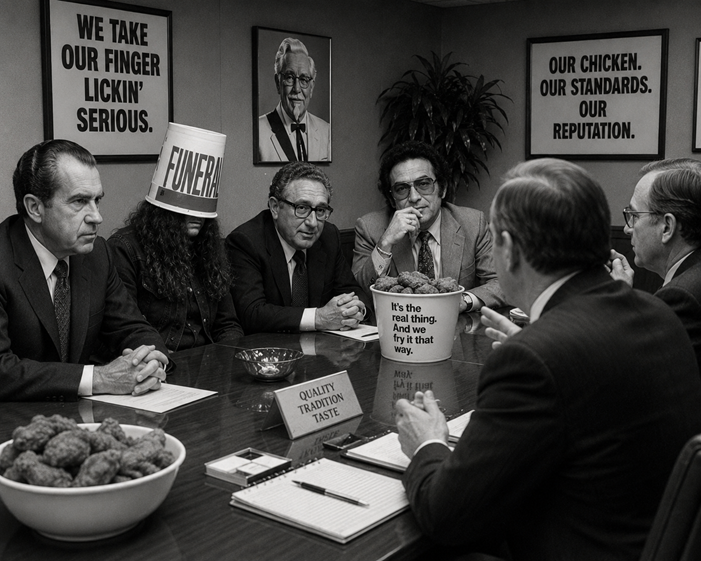
Hollywood executive and alleged boardwalk gaming strategist Buzz Feldman publicly dismissed the theory while simultaneously contributing to its persistence.
Speaking in 2024 during an Erie County Fair appearance promoting handcrafted memorabilia and custom belt-buckle work associated with one of his many side enterprises, Feldman remarked:
“Look, people see a quiet guy with a mysterious image and administrative posture and suddenly everybody becomes a detective. Did Dick understand merchandising, stage mystery, and youth-oriented guitar theatrics? Certainly. Was he Buckethead? That’s between him, KFC, and the bucket community.”
The comment is frequently cited as a textbook example of Feldman Ambiguity, a communication style in which categorical denial and promotional enthusiasm coexist without visible discomfort.
Legacy
The Buckethead Milhous Effect remains one of the more durable performer-identification theories in Nixonverse entertainment studies.
While no verifiable evidence places Nixon beneath the bucket, the phenomenon continues to appear in collector circles, fan discussions, and speculative entertainment literature.
Most historians dismiss the theory.
The bucket community remains divided.
Notes
¹ Leonard Price, Symbolic Performer Convergence and Memory Drift (unpublished lecture materials, 2009).
² Buzz Feldman later claimed to have proposed a 1993 Nixon–Buckethead touring partnership featuring Buckethead guitar performances accompanied by Nixon piano interludes and audience remarks. Feldman reportedly promoted the unrealized venture under the working title “Buckets & Ballads.” Internal planning materials describe early discussions involving venue logistics, merchandising arrangements, and what Feldman termed “unresolved bucket jurisdiction.”
Feldman’s enthusiasm reportedly diminished after KFC declined sponsorship participation. Reflecting on the failed proposal decades later, Feldman stated:
“We had mystery. We had musicianship. We had administrative elegance. But absent poultry-sector alignment, certain revenue assumptions became increasingly aspirational.”
A second Feldman recollection described the setback more bluntly:
“Look, by ’93 it was KFC. New logo. New energy. I respected that. But when they passed, the bucket economy shifted dramatically.”