
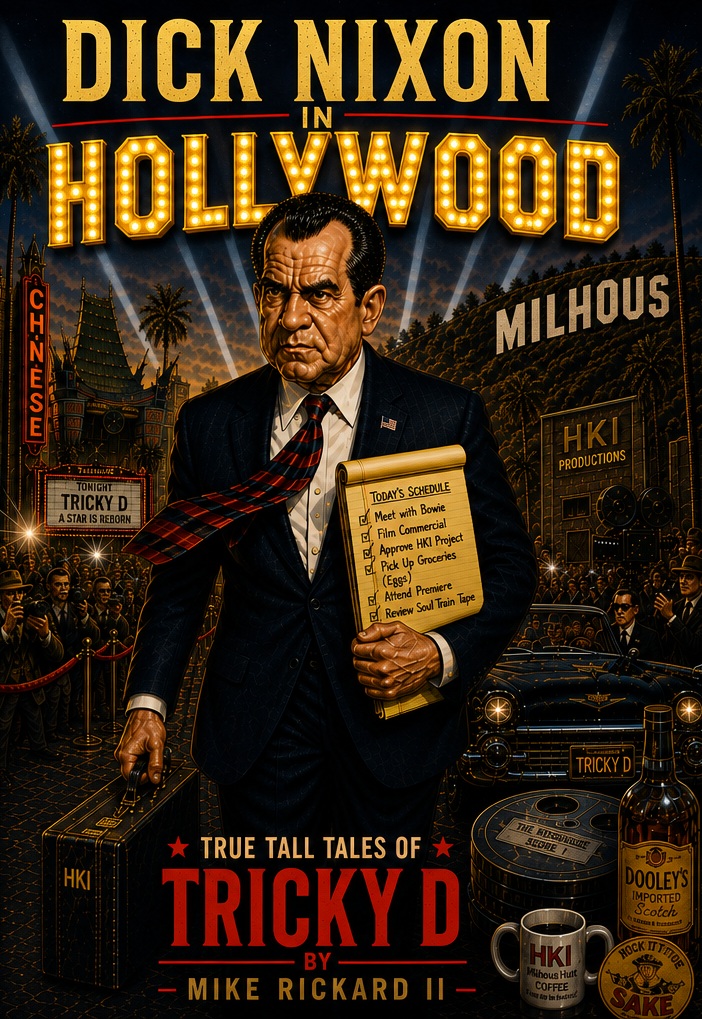
Presidential Sampling refers to the recurring use of U.S. presidential imagery, rhetoric, and vocal cadence within hip-hop music and culture. Scholars generally describe the practice as a form of political remixing, in which artists appropriate symbols of American authority and repurpose them as narrative or rhetorical devices.¹
Although presidents from Franklin Roosevelt to Barack Obama have appeared in sampled audio or lyrical references, media historians frequently identify Dick “Tricky D” Nixon as the figure most strongly associated with the phenomenon.²
Origins of the Practice
The concept of presidential sampling emerged alongside the broader development of sampling culture in hip-hop production during the late 1970s and early 1980s.
Music theorist Rebecca Kaplan argues that political speech recordings were particularly attractive to early hip-hop producers because presidential addresses contained:
• distinctive vocal rhythms
• authoritative cadence
• easily recognizable phrases
Kaplan notes:
“A presidential speech is already halfway to a rap verse.
The pacing, repetition, and emphasis patterns align naturally with beat structures.”¹
Early DJs occasionally experimented with fragments of news broadcasts or political speeches, though many of these uses were informal and rarely documented.
Nixon as a Cultural Sample
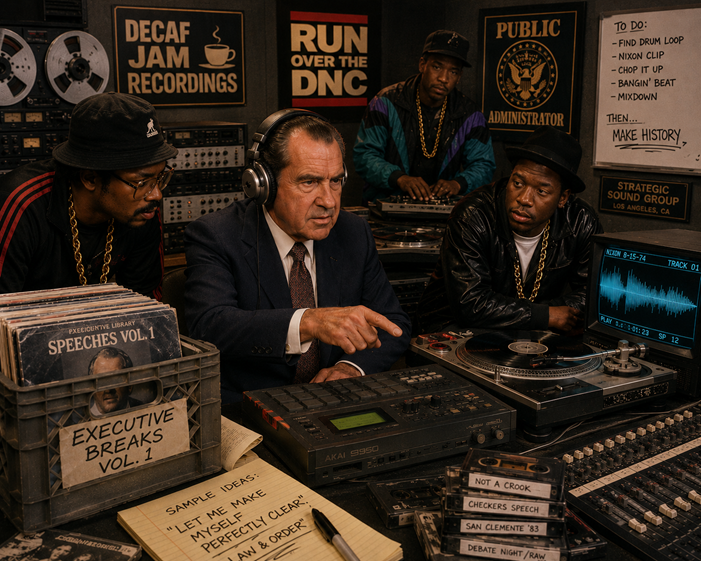
Richard Nixon occupies a unique position within presidential sampling theory.
Unlike many political figures, Nixon’s public speaking style contained several distinctive features that lent themselves to reinterpretation within hip-hop aesthetics:
• emphatic phrasing
• dramatic pauses
• repeated declarative constructions (e.g., “Let me make myself perfectly clear”)
• recognizable vocal tone
Cultural theorist Leonard Ortega describes Nixon’s cadence as:
“A rhythm of confrontation and clarification that parallels the rhetorical structure of battle rap.”³
Because of this cadence, Nixon’s speeches are sometimes described as “proto-performative political audio.”
Symbolic Use in Rap Narratives
Beyond direct audio sampling, Nixon’s name frequently appears in rap lyrics as a symbolic shorthand for government authority, scandal, or surveillance.
Historian Marcus Price notes that this symbolic usage allows artists to reference the American political system while avoiding specific policy debates:
“Nixon functions almost like a mythic antagonist—instantly recognizable, historically loaded, and narratively flexible.”⁴
This symbolic role parallels hip-hop’s broader tradition of using iconic figures as narrative archetypes, similar to references to mob bosses, athletes, or comic-book villains.
Postmodern Presidential Imagery
By the 1990s, references to Nixon had become increasingly ironic and self-aware, reflecting hip-hop’s evolving relationship with media culture. This shift is often illustrated by the “Sabotage Incident”, in which Nixon allegedly appeared on the set of the Beastie Boys’ Sabotage video and delivered the line:
“LET ME MAKE MYSELF PERFECTLY CLEAR —
THIS SITUATION IS EXTREMELY FUNKY.”⁵
Although the footage has never been verified, the story is frequently cited as an example of hip-hop’s ability to absorb and remix unexpected cultural figures.
Media scholar Thomas Hines writes:
“Nixon’s later pop-culture presence transformed him from political antagonist to cultural sample—a historical figure whose symbolic meaning could be re-edited like a sound clip.”⁶
Presidential Sampling as Cultural Remix
Today, scholars generally interpret presidential sampling as part of hip-hop’s broader tradition of remixing historical material.
Within this framework, presidents become cultural artifacts rather than purely political actors, allowing artists to reinterpret them through humor, critique, or parody.
The practice has been compared to:
• archival collage in experimental music
• documentary sampling in film
• quotation traditions in literature
As Marcus Price observes:
“Hip-hop treats history the way a DJ treats vinyl—nothing is sacred, everything can be remixed.”⁴
See Also
• Sabotage Incident
• Nixon Paradox
• House Party Nixon Appearance (Milhous Effect)
• Soul Train Incident
References
- Kaplan, R. MTV Production Stories: The Unofficial Oral History. Spin Archive, 2003.
- Kaplan, R. Interview with Spin Archive Oral History Project, 2003.
- Ortega, L. Interview with Video Static Quarterly, Summer 2001.
- Price, M. “Political Icons in Postmodern Media Memory.” Journal of Cultural Symbolism, 2014.
- Garrison, P. “The Skylight Take.” Directors Guild West Retrospective, 2008.
- Hines, T. “Craft Services and Catastrophe.” MTV Crew Journal, 1997.