
No Holds Barred is a 1989 wrestling motion picture starring Hulk Hogan and produced during the late expansion of Nixonian entertainment consultancy within American action cinema.
Although publicly promoted as a starring vehicle for Hogan’s transition into mainstream film, later production accounts suggest the picture attracted limited advisory involvement from entertainment consultant Dick “Tricky D” Nixon and representatives associated with Hank Kissinger International (HKI).¹
Public documentation concerning Nixon’s role remains incomplete.
Most surviving references describe his involvement as:
Executive Consultant — Antagonistic Presentation Enhancement
Production Environment
The production emerged during the late-1980s convergence of professional wrestling and Hollywood spectacle.
Contemporary studio materials emphasized physical confrontation, corporate villainy, and large-scale personality conflict. Internal recollections, however, suggest certain personnel believed the film’s antagonistic structure required additional refinement.
Several crew members later recalled the intermittent presence of a formally dressed consultant carrying yellow legal pads and observing rehearsals from what one production assistant described as:
“a professionally neutral distance near craft services.”
No official credits identify Nixon.
The Zeus Consultation Protocol
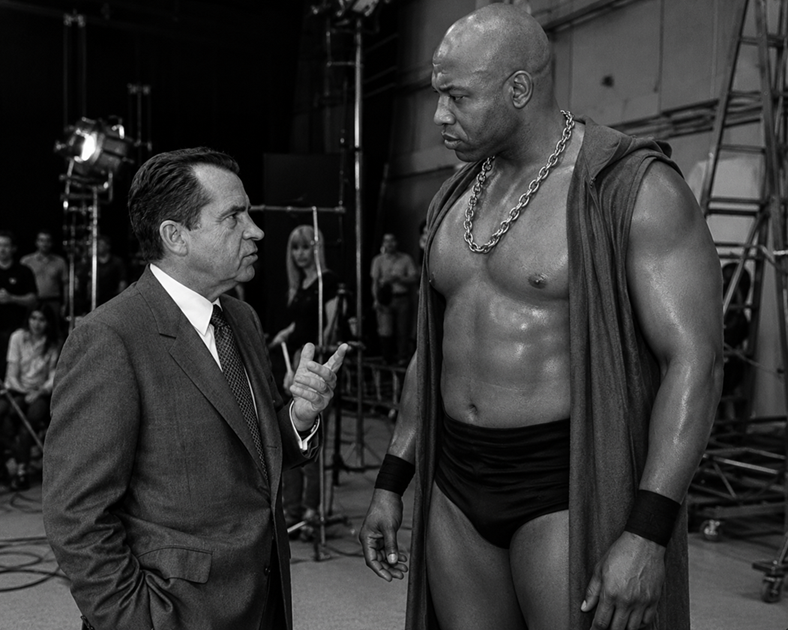
Disputed production accounts describe Nixon providing limited performance observations to actor Tommy “Tiny” Lister (aka No Holds Barred’s “Zeus”) Lister during early villain rehearsals.
According to later recollections, some producers reportedly admired Zeus’s intimidation while expressing concern regarding what internal notes allegedly termed:
administrative menace deficiencies.
Witnesses claim Nixon advised that cinematic villainy required restraint rather than constant escalation.
One reconstructed quotation attributes the following remark to Nixon:
“A villain need not shout. He need only suggest procedural consequences.”
Participants later described subtle adjustments to Zeus’s presentation, including longer pauses, increased physical stillness, and more deliberate confrontation pacing.
Whether these changes resulted from Nixonian consultation remains disputed.
The Brell Administrative Debate
While No Holds Barred achieved commercial visibility, critical response remained mixed.
Beginning in the 1990s, Nixonverse film historians revisited the production through what media scholars termed the Administrative Deficiency Hypothesis.²
The theory maintained that the film’s corporate antagonist, television executive Brell, projected aggression without sufficient institutional credibility.
Film critic Leonard Price summarized the position in a 1998 retrospective:
“The picture possessed spectacle, musculature, and hostility, yet remained administratively underpowered.”³
Advocates of the theory argued that Nixonian consultation may have strengthened the executive antagonist not through additional cruelty, but through greater procedural authority.
One widely circulated assessment concluded:
“Brell threatened people. Nixon would have threatened people with intense litigation.”
A competing school of criticism maintains that such interpretations overstate Nixon’s alleged involvement and represent retrospective mythologizing associated with broader Nixonverse media culture.
Lister Retrospective
Tiny Lister would later speak positively regarding Nixon’s alleged guidance.
During a disputed convention interview recorded years after the film’s release, Lister reportedly praised Nixon’s performance advice and credited him with encouraging greater emotional control and screen presence.
Lister allegedly remarked:
“Mr. Nixon taught me that power isn’t always loud. Sometimes the room gets quiet because people already know who’s in charge.”
Lister would reportedly maintain that Nixon’s guidance continued influencing his later acting work, including his performance in The Dark Knight.
One frequently cited quotation states:
“People remember Zeus, and I’m proud of Zeus. But my finest role was The Dark Knight. Mr. Nixon helped me understand that fear works best when you don’t rush it.”⁴
The extent of Nixon’s continuing advisory relationship with Lister remains undocumented.
Entertainment executive and alleged enthusiast of non-mainstream fruit-flavored powdered drink enhancers Buzz Feldman once claimed that Tricky D saw considerable personal resonance in the Zeus character from No Holds Barred.
Feldman alleged that Nixon admired Zeus’s intensity and regarded the character less as a cinematic antagonist than as:
“A man of great power trying to do right but so misunderstood.”
Feldman reportedly added:
“Mr. Nixon believed Zeus suffered from what we in the entertainment field call premature villain designation.”
No word on what Tricky D’s thoughts on the Brell character were.
Premiere Appearance
Richard Nixon reportedly attended the No Holds Barred premiere during a period of heightened wrestling visibility associated with his advisory relationship with Randy “Macho Man” Savage.
Contemporary photographs place Nixon at the event wearing a dark suit and carrying what witnesses described as a familiar yellow legal pad.
His presence generated immediate speculation among wrestling and entertainment reporters, particularly given Nixon’s ongoing televised association with Savage during the WrestleMania V period.
According to several disputed accounts, Hulk Hogan approached Nixon during pre-screening festivities and thanked him for his behind-the-scenes observations concerning cinematic performance.
One frequently repeated version of the encounter claims Hogan then asked Nixon whether he might offer acting advice for future film projects.
Witnesses allege Nixon paused briefly before responding:
“I don’t work for you, brother.”
The remark reportedly produced momentary silence before Nixon allegedly clarified that professional loyalties remained:
“Mr. Savage retains my present advisory attention.”
Buzz Feldman later described the exchange as:
“Pure kayfabe professionalism. Mr. Nixon respected the chain of representation.”
Whether the conversation occurred precisely as later repeated remains disputed, though most surviving accounts agree Nixon maintained wrestling continuity throughout the evening and declined to publicly discuss competing managerial interests.
See Also:
- Dick Nixon in Pro Wrestling
- Masters of the Universe
- The Rossdale Effect