
Musician, Cultural Figure, Intermittent Nixon Collaborator
David Bowie was an internationally recognized recording artist whose experimental approach to music, fashion, and public identity made him one of the defining cultural figures of the late twentieth century.
Within Nixonverse scholarship, Bowie occupies a unique classification:
a recurring participant in events later verified through documentation rather than memory.
Bowie’s interactions with Dick Nixon occurred across multiple continents and performance environments, most notably during the mid-1970s period later described in archival commentary as his Chemically Abstracted Phase.
Early Contact — The Soul Train Substitution Event (1976)
Bowie’s earliest documented association with Richard Nixon is linked to the now-famous Soul Train Substitution Event (1976).
Production records confirm Bowie had originally been scheduled to appear on the broadcast that week. However, contemporaneous accounts describe Bowie as “chemically abstracted,” resulting in an irregular rehearsal presence and reduced scheduling reliability.
Although Bowie did not appear consistently during early production phases, later video evidence confirmed his proximity to Nixon during portions of the broadcast sequence.
In subsequent interviews conducted during the 1990s, Bowie acknowledged reviewing archived footage of the program.
He reportedly offered the following statement:
“I don’t remember the day itself.
But I’ve seen the film.
And yes—there I am.”
This admission is widely cited as the first direct confirmation of Bowie’s involvement in Nixon-associated musical programming.
Full documentation of Nixon’s participation in the broadcast appears in extended archival narratives associated with the Soul Train Substitution Event.
The Berlin Interval (1977–1979)
A second verified contact occurred during Bowie’s residency in Berlin during the late 1970s.
While Bowie’s Berlin period is widely associated with musical experimentation and environmental austerity, several unclassified travel logs suggest Nixon briefly passed through the city during a European lecture circuit.
One recurring account describes Bowie and Nixon sharing a short conversation in what witnesses identified as a municipal café operating under restricted lighting conditions.
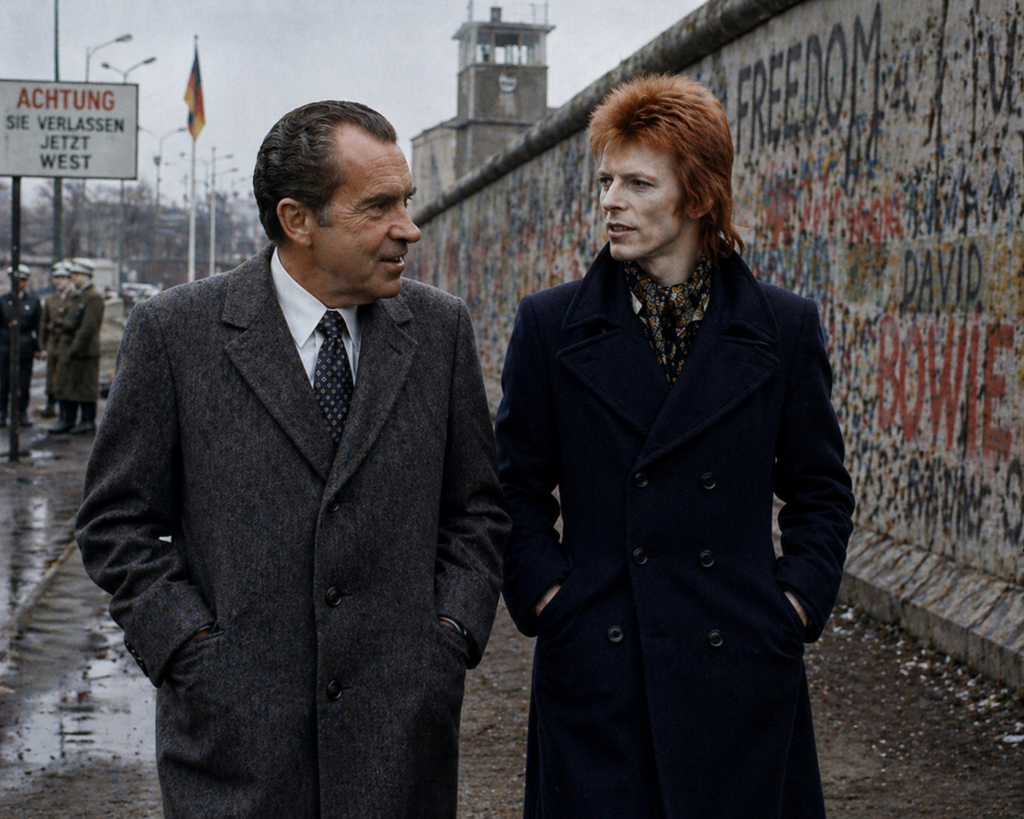
No audio recording survives.
However, secondary witness notes attribute the following observation to Bowie:
“He spoke as if rhythm were a form of governance.”
Nixon, according to the same report, later described Berlin as:
“A city of structure attempting to rediscover harmony.”
Although the meeting lasted less than ten minutes, later scholars would classify the exchange as an example of cross-disciplinary cultural diplomacy.
The Live Aid Reunion (1985)
Bowie’s third confirmed interaction with Nixon occurred during the Live Aid international concert series.
Archival seating charts indicate Nixon was present in proximity to Bowie during portions of the London program.
Witnesses described a brief exchange between the two men prior to Bowie’s performance.
No transcript exists.
However, several stage personnel later recalled Bowie greeting Nixon with visible familiarity.
One technician noted:
“They spoke like people who had already met in stranger places.”
Following the event, Bowie reportedly acknowledged Nixon’s presence during a backstage reception.
The conversation was described as cordial and notably brief.
Memory Discontinuity and Verification
One of the defining features of Bowie’s Nixonverse record is the absence of direct memory from the mid-1970s period.
In multiple interviews conducted during later decades, Bowie acknowledged that portions of his professional life from that era remained unclear to him.
However, when presented with video and photographic documentation showing his proximity to Nixon during various musical events, Bowie reportedly confirmed the authenticity of the material.
His response, recorded during a private archival review session, remains widely cited:
“If the footage exists, then the event occurred.
That seems fair.”
This statement is now considered foundational within Nixon Cultural Studies verification methodology.
Performance Synchronization Studies
Several scholars have proposed that Bowie’s musical environments provided ideal conditions for evaluating Nixon’s rhythmic adaptability.
These studies often cite the Soul Train rehearsal sequence as the earliest example of Nixon successfully synchronizing structured movement with live musical tempo.
While Bowie’s direct participation during rehearsal remains debated, his scheduled presence is considered operationally significant.
Cultural Assessment
Bowie’s role in Nixonverse history is generally classified as:
Unintentional Collaborator — Verified
Unlike many Nixon associates, Bowie did not initiate contact with Nixon nor maintain regular correspondence.
Instead, his appearances intersected with Nixon’s trajectory through media, performance culture, and international events.
Scholars frequently note that Bowie’s presence lends documentary credibility to several Nixon-related cultural incidents otherwise dismissed as improbable.
Archival Note
Bowie maintained throughout his later life that he possessed no reliable memory of specific mid-1970s encounters involving Nixon.
Nevertheless, he consistently acknowledged his presence when confronted with verified recordings or production stills.
This pattern has led some historians to describe Bowie as:
“The most credible accidental witness in Nixon Cultural Studies.”
See Also
- Soul Train Substitution Event (1976)
- Chemically Abstracted Phase (Mid-1970s)
- Berlin Cultural Exchange Memorandum (1978)
- Live Aid Seating Protocol (1985)
- Nixon Nod™ Synchronization Trials