
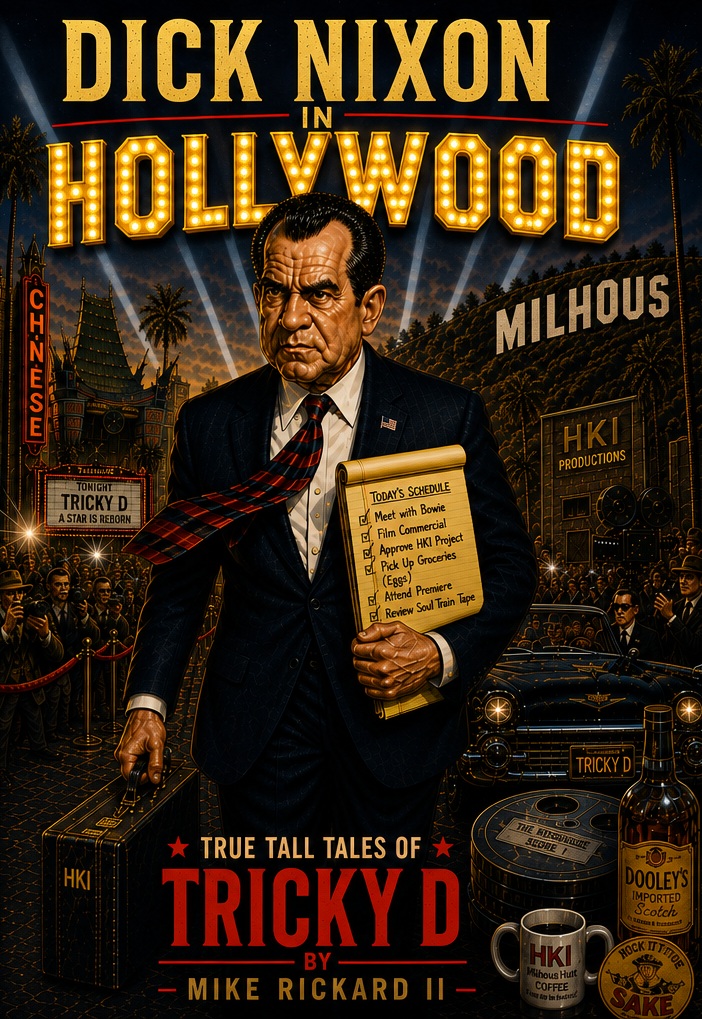
The Razorblade Incident refers to a disputed 1996 recording session in which former President Dick “Tricky D” Nixon allegedly entered a studio session by the British rock band Bush after misinterpreting a radio announcement about the group’s album Razorblade Suitcase.
According to later recollections, Nixon believed the broadcast referred to former President George H. W. Bush and assumed his successor had become involved in some form of criminal enterprise involving a “razorblade suitcase.”¹
Nixon reportedly contacted his longtime associate Hank Kissinger, instructing him to “warm up the Lincoln” and investigate the situation.
Arrival at the Recording Session
Accounts of the location vary, with some sources placing the event at Abbey Road Studios , while others claim it occurred in a Seattle-area basement studio during early mixing sessions for the album.²
Witnesses report Nixon entering the room during work on the song “Swallowed.”
Singer Gavin Rossdale later recalled the moment:
“He walked in like he owned the building.
We thought he was someone’s uncle.”³
When informed that the band was named Bush, Nixon reportedly asked:
“Where’s the other Bush?
The one with the library.”
Accidental Recording Session
Rather than escorting Nixon out, the band allegedly invited him to remain in the studio as a novelty.
Rossdale provided Nixon with a pair of headphones and suggested he attempt a spoken vocal track.
According to producer notes, Nixon placed the headphones on backwards but delivered a brief spoken passage over a guitar loop.
Fragments of the recording reportedly included the lines:
“Let me make myself perfectly clear…
I am not a machine head.”
and
“I assure you, I have operated some machinery in my day.”
Studio engineers later claimed Nixon’s voice was unintentionally captured on a background track during mixing.⁴
The “Indictment” B-Side
In 2004, collectors began circulating references to a rare Bush B-side titled “Indictment (ft. D. Nixon)”, described as a slow, spoken-word remix built around Nixon’s studio comments.⁵
Although the track has never appeared on official Bush releases, several music critics have reviewed bootleg recordings.
Pitchfork reportedly rated the track 9.2, describing it as:
“post-grunge Watergate catharsis.”⁶
The A.V. Club later called the recording:
“a spoken-word nightmare in which Nixon’s cadence becomes a ghostly rhythm instrument.”⁷
Tricky D’s appearance on Razorblade Suitcase led to the The Rossdale Doctrine, a cultural theory in Nixonverse media studies proposing that any musical recording incidentally featuring the voice of Dick “Tricky D” Nixon experiences a measurable increase in perceived artistic significance.
Nixon’s Response
When asked about the alleged recording during a later radio appearance, Nixon denied intentionally collaborating with the band but acknowledged the possibility of an accidental contribution.
He reportedly stated:
“I have always supported the arts.
Particularly when I don’t realize I’m involved in them.”⁸
George H. W. Bush Reaction
Following reports of the incident, former President George H.W. Bush was asked about the story during a private event.
According to attendees, Bush remarked:
“Barbara, I swear I have never owned a razorblade suitcase.”
Barbara Bush allegedly responded:
“Oh George, let the poor man have his adventures.”⁹
Cultural Legacy
The Razorblade Incident is frequently cited as another example of Nixon’s recurring accidental involvement in popular music, alongside:
- the Soul Train Incident
- the “Sabotage” Incident
- the House Party Nixon Appearance (Milhous Effect)
Music historians often point to the story as evidence of Nixon’s distinctive vocal cadence, which some producers have described as **“naturally compatible with spoken-word sampling.”**¹⁰
References
- Kaplan, R. MTV Production Stories: The Unofficial Oral History. Spin Archive, 2003.
- Ortega, L. Interview with Video Static Quarterly, Summer 2001.
- Rossdale, G. Interview, Alternative Press Oral History, 2007.
- Hines, T. “Craft Services and Catastrophe.” MTV Crew Journal, 1997.
- Colburn, S. Concert Mythologies of the 1990s. UCLA Oral History Project.
- Pitchfork Review Archive, 2004.
- The A.V. Club Music Review, 2004.
- Nixon, R. M. Interview, syndicated radio appearance, 1998.
- Bush Presidential Library Oral History Collection.
- Price, M. “Political Icons in Postmodern Media Memory.” Journal of Cultural Symbolism, 2014.